

A little mid-week breather between this morning’s Fourth Branch / Article 0 piece and Sunday’s Article 3 drop … that you don’t actually know is coming yet …. Whoops, okay, it is. Article 3 in the Observations series drops on Sunday, 4/12/26.
My wife and I decided to mix it up last night and headed to our local wine bar here in a small town in Western WA — the one that’s literally just 1 mile from the house, all quiet neighborhood streets. Half-price wine bottle Wednesday made it easy to skip our usual pub (and bartender Shauna, who makes a fantastic Old Fashioned) for something a little more relaxed.
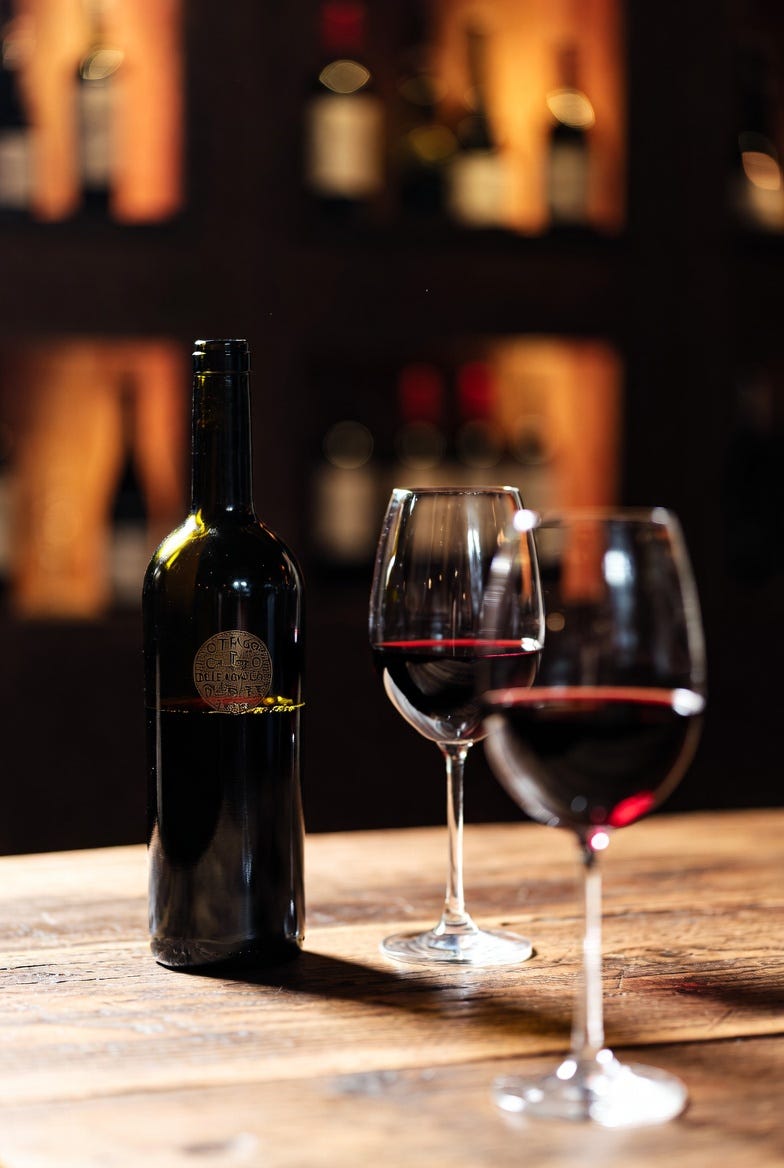
We settled in with a solid bottle, enjoying dinner and chatting about current events — the situation in Iran and that F-15 WSO who had to escape and evade. That quickly turned into me sharing stories from my early Army days in Fulda with the 11th ACR and going through SERE-C at Bad Tolz back in the 1980s. My wife never knew me then, so she was asking for all the recaps, laughing especially at the part where the cadre captured me and tossed me in the mud pit.
Right in the middle of it, the guy at the table next to us leans over and says, “Excuse me… are you talking about SERE?”
Turns out he’s a Navy pilot who did his SERE training in San Diego with SEAL instructors — basically the naval counterpart to the version run by Army Special Forces in Bad Tölz. We clicked instantly and started swapping stories: the evasion phase, the instructors, the misery… and at one point we got to the part where they teach you what the enemy might do. I started to say “Right, that means…” and he literally finished my sentence: “…waterboarding isn’t torture because they did it to us.”
We both cracked up. It instantly took me back to the mid-2000s when it came out that the CIA was waterboarding al-Qaeda types at Gitmo. Everyone was screaming that it was torture, and I remember being genuinely bewildered — because waterboarding is exactly what they do to you at SERE to teach you about torture and how to resist it. Same training, same technique, just different context.
We both agreed that if someone actually waterboarded us today, in about 30 seconds flat we’d be spilling every embarrassing secret we’ve ever had — including the random lie we told our grandma when we were seven and thought we’d gotten away with forever. That’s how fast and how completely it breaks you.
And yeah, it’s nasty and brutal while it’s happening — you feel like you’re drowning and your body is screaming for it to stop. But here’s the thing that always struck me: it does all of that without doing any real physical harm. No broken bones, no electric shocks, no yanked fingernails, no lasting damage like the old-school tortures you read about in history books. It creates this overwhelming psychological pressure where you desperately want to tell the truth (or anything) just to make it end, yet you walk away physically untouched.
Both our wives just sat there rolling their eyes in perfect sync with that universal “here we go again” look while the two of us bonded over the shared experience.
The whole evening was easy and fun… until, as often happens when you hang out with me, the conversation took a hard left turn into ancient history.
Somehow we got onto Rome. My wife and I started talking about how modern people really don’t grasp the sheer gravity of what Rome was — the scale, the ruthlessness, the long shadow it still casts. That led straight to Carthago delenda est — Cato the Elder’s famous refrain that Carthage must be destroyed. And from there, the reality that the Third Punic War gave us what is arguably the first historically debated and recorded genocide in Western history: the complete destruction of Carthage in 146 BC. Not just defeat — the city was razed, its people killed or enslaved, its fields sown with salt so nothing would ever grow again. Total annihilation as state policy.
We sat there over the last of the wine, talking about how casually we toss around phrases like “Carthage must be destroyed” today, without really feeling the weight of what that actually meant for an entire civilization. Rome didn’t just win a war; it erased a rival so thoroughly that we’re still arguing about the details more than two thousand years later.
I circle back to Rome for the same reason the Founders did. There are timeless lessons to be learned.
Small world doesn’t even begin to cover the night. A random SERE connection at a neighborhood wine bar, followed by a deep dive into one of history’s darkest lessons — all within walking distance of home.
Definitely not our standard Wednesday.
Eric, great memories, great story.
I didn’t know that you were SF. Respect to you! I was at Bad Tölz in the 60s with 10th SFG. Wonderful place. Did you know that Flint Kaserne had been the site for the SS equivalent of OCS? And I think that General Patton had a HQ there for a while.
John Lucas
Bravo Blue Substack