


In the summer of 1787, a small group of men met in Philadelphia to rescue a failing nation. What they produced was not perfect, but it was brilliant in its pragmatism.
Opening Hook
Philadelphia, May to September 1787. Behind closed windows in the sweltering heat of the Pennsylvania State House, fifty-five delegates gathered in secret. The United States, barely four years old as an independent nation, was already on the verge of collapse under the weak Articles of Confederation.
Many of the men who walked into that room believed the Convention would fail. Some thought the union itself was doomed. The states were squabbling, debt was crushing, trade was paralyzed, and Shays’ Rebellion had shown just how fragile the young republic really was. European powers watched with interest, waiting for the American experiment to disintegrate so they could pick up the pieces.
Yet from this crisis emerged one of the most remarkable acts of statesmanship in history.
Section 1: The Crisis They Faced
The delegates arrived with deep, seemingly irreconcilable divisions:
Big states versus small states, each fearing domination by the other.
North versus South, with sharply different economies and interests.
Commercial interests versus agricultural ones.
Advocates of a strong national government versus fierce defenders of state sovereignty.
Slavery loomed as one of the most difficult issues. Many delegates, especially from the North and Upper South, believed slavery was economically inefficient and morally wrong, and that it would naturally wither away over time.
Reality: If the weak Articles of Confederation remained in place, the American nation was so fragile that the European powers (especially Britain, France, and Spain) would almost certainly divide it up and reconquer at least big chunks of the continent.
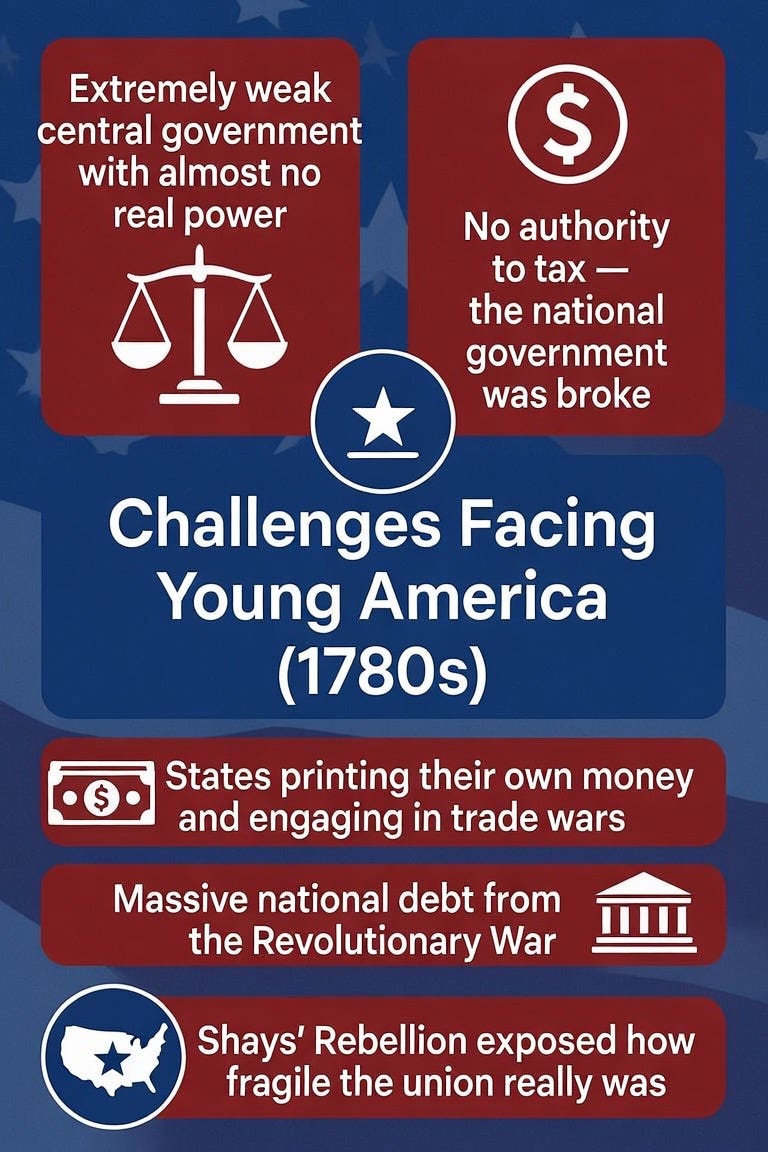
The delegates were not starry-eyed idealists. They were practical, ambitious, often disagreeable men who understood they were operating in a dangerous world. They knew that if they could not find common ground, the United States would likely fracture, and the grand experiment in self-government would die in its infancy.
Section 2: The Brilliance of Compromise
The Articles of Confederation themselves were the ultimate anti-compromise, a document in which no state was required to give up any meaningful sovereignty, rendering the national government almost powerless.
Faced with these divisions, the delegates did something extraordinary: they compromised.
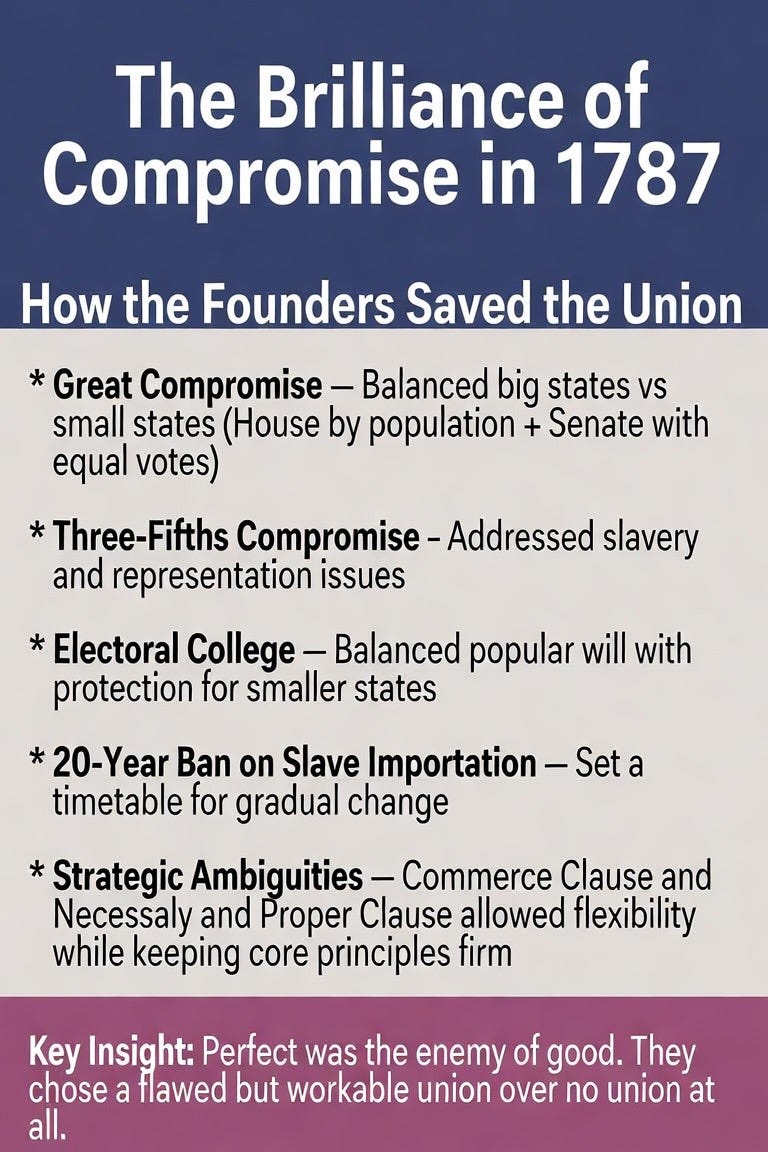
The pivotal moment came with the Great Compromise (also called the Connecticut Compromise). This was most notable for addressing everyone’s deep fear of Virginia, by far the largest and most powerful state. Large states wanted representation based on population. Small states feared being swallowed. The solution was elegant in its simplicity: a bicameral legislature with a House of Representatives based on population and a Senate with equal representation for each state. This single compromise saved the Convention and laid the foundation for the new government.
Other difficult bargains followed. The Three-Fifths Compromise and the twenty-year ban on the importation of slaves were pragmatic measures designed by delegates who expected slavery to gradually decline. Most believed these provisions would set it on a path to eventual extinction.
The Electoral College was another brilliant, if messy, compromise. It balanced popular will with protection against pure mob rule and gave smaller states a meaningful voice in choosing the President.
Throughout the document, the Founders deliberately included ambiguities, such as the Commerce Clause and the Necessary and Proper Clause, that allowed the Constitution to be both firm in its principles and flexible enough to adapt to future challenges.
These were not perfect solutions. They were practical ones. The delegates understood that a flawed union was infinitely better than no union at all.
Section 3: Why This Was Extraordinary
These men were not demigods. They were flawed, ambitious, often disagreeable, and deeply divided on many issues. Some owned slaves. Some were idealists. Some were pragmatists. Many distrusted one another.
Yet they chose compromise over ideological purity.
They understood something that seems increasingly rare today: that perfect is the enemy of good, and that a flawed but functional union was infinitely better than no union at all. They were willing to accept imperfect solutions in order to build something that could endure.
This willingness to compromise was itself extraordinary. In an age of revolution and upheaval, they rejected radicalism in favor of careful, deliberate statesmanship. They designed a system not for saints, but for ordinary, imperfect people living in a dangerous world.
In stark contrast to much of modern politics, where compromise is often treated as betrayal or weakness, the Founders treated it as the highest form of statesmanship.
Section 4: The Deeper Lesson
The Constitution was not a libertarian or progressive manifesto. It was a practical, hard-won bargain designed for imperfect people living in a dangerous world.
It deliberately made change difficult, not because the Founders were reactionaries, but because they understood how quickly republics can descend into tyranny or chaos. The Constitution’s brilliance wasn’t in creating a perfect system, rather it was in creating one durable enough to survive imperfect leaders and citizens.
Conclusion
Two hundred and fifty years later, we still live under the system those men designed in that hot Philadelphia summer. The genius of 1787 was not perfection, but the willingness to compromise for the greater good.
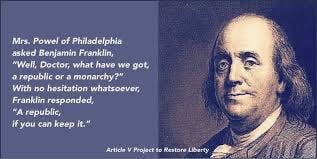
In our own time of Late Republic crisis, the spirit of working together for the common good is one we need to rediscover. In 1787, the men that wrote the Constitution started with a single compromise to find a solution to what seemed an intractable problem. That led to further agreement and solutions. We need to find that spirit within ourselves again.
Further Reading
Miracle at Philadelphia by Catherine Drinker Bowen — The classic, highly readable account of the Constitutional Convention.
The Summer of 1787 by David O. Stewart — Excellent narrative history that captures the drama, arguments, and compromises of that fateful summer.
The Grand Convention by Clinton Rossiter — A thoughtful analysis of the delegates and the political genius behind the Constitution.
Founding Brothers by Joseph J. Ellis — Especially strong on the spirit of compromise and the difficult bargains the Founders made.
Plain, Honest Men by Richard Beeman — A detailed and balanced look at how the delegates forged agreement despite deep divisions.
America 250
#Observations #LateRepublic #America250 #Founders
All Observations from the Late Republic posts
Wonderful discussion of the how and why of the Constitution. Thank you.