

Yet again, the internet is having another holy war about 1911s vs Glocks vs Sigs. Fine. But let’s get something straight first. The pistol you choose is the least important part of being a Modern Minuteman.
I’ve carried a gun for decades.
I’ve carried first aid gear for decades.
I’ve given first aid to, used tourniquets on, or bandaged, at least a dozen people in my life.
I’ve shot zero people — outside of combat.
Let that sink in.
If you’re brand new to being prepared for a crisis and you only have time or money for one thing right now, start with medical gear and training. Because that is going to be the single most effective thing you can do to help your fellow humans in a bad situation. A pistol you can’t use effectively (or a gunshot wound you can’t stop) will get you or someone you care about killed just as fast as having no gun at all.
So You Still Want a Pistol
Good. When people ask me at the range or in real life what they should buy as their first serious defensive pistol, here’s what I actually tell them:
Go to a good local gun store you trust. Talk to the staff. Handle a bunch of pistols. Rent several at their range and shoot them for real. What feels good in your hands, runs well for you, and you actually enjoy shooting is usually the right choice. No internet expert (including me) can tell you that from a keyboard.
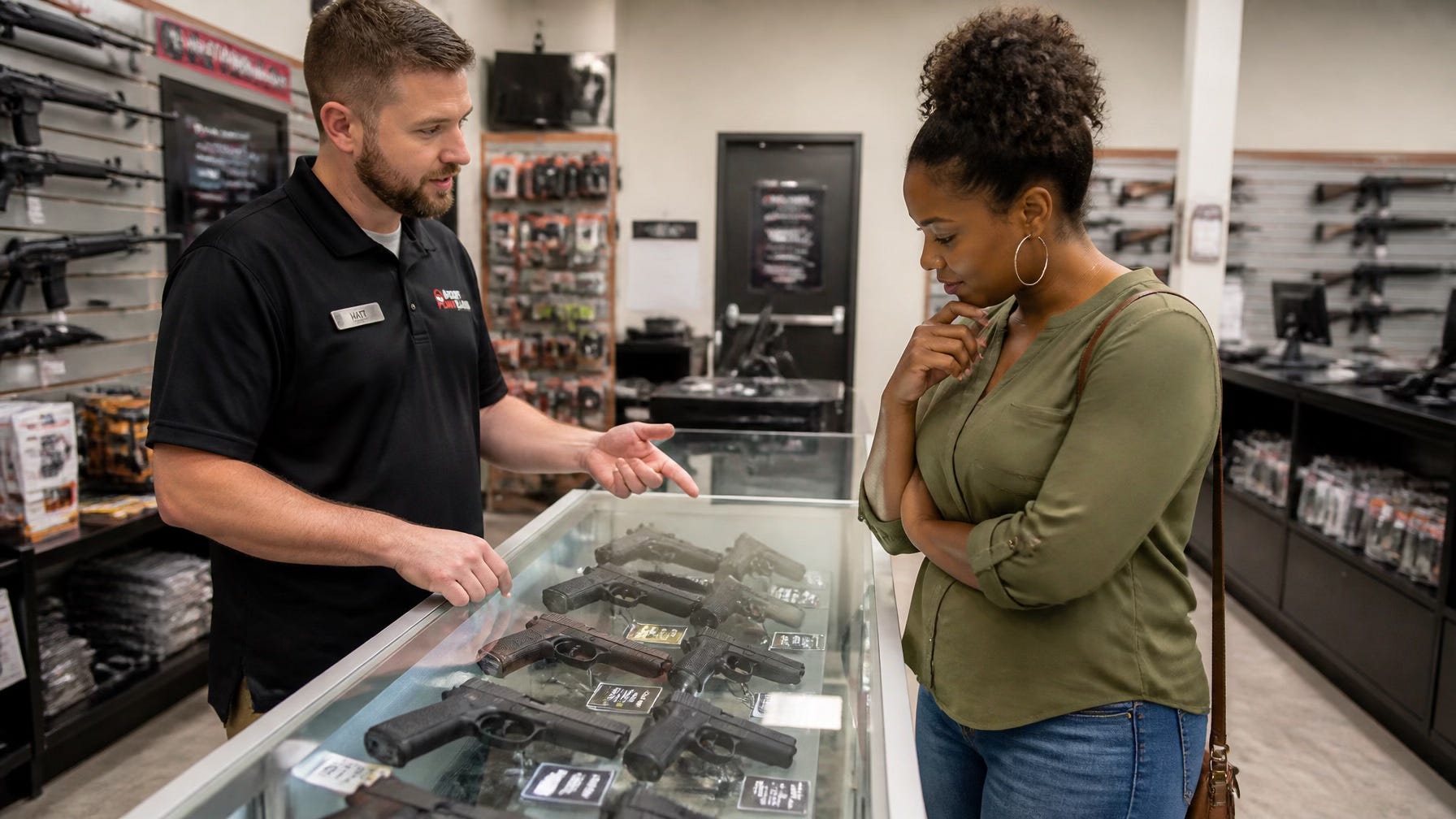
Quick real-world note from my experience as Chief RSO at a semi-rural gun club in Washington State:
The most common “what gun should I buy for self-defense?” conversations I have are women. It’s extremely rare that a man, even an obvious beginner, asks for advice. That’s just anecdotal, but anecdotes are still data.
Only if someone keeps pushing and says “No, really — what would you buy?” do I give them my personal recommendations.
My Personal Recommendations (If You Insist)
Any Carry to Full Size striker fired 9mm pistol that is made by a quality manufacturer such as Smith & Wesson, Springfield Armory, Sig Sauer, Glock, Ruger, CZ. You will find it far easier to learn the fundamentals of pistol marksmanship with a Full Size pistol than a compact or sub-compact. And, as you will find out at the range, you are not going to pick up a pistol and immediately be John Wick 2.0.
Once you know how to shoot, are comfortable with pistols, and feel ready to carry a concealed pistol, we can move on to a compact pistol intended for concealed carry.
If someone insists on my concealed carry recommendation, here’s what I tell them.
Best All-Around Choice for Most People in 2026:
Sig Sauer P365 XL (or the XMacro if you have bigger hands or want more capacity)
Compact enough for daily carry, big enough to shoot well
Decent trigger
Optics-ready out of the box - and yes, you should put a red dot on it.
Reliable as hell - I’ve got 2500 rounds through mine without a single failure
Strong Contenders:
Glock 19 or 43X MOS
CZ P-10 C
Smith & Wesson M&P 2.0 Compact
Springfield Armory Echelon 4.0C or XD-M Elite Compact OSP
If You’re Dead-Set on a 1911…
Which is not a bad choice — I own several of them myself. And carried a 1911 as my daily concealed carry until just recently.
Buy a good one.
Middle-of-the-pack good: Kimber, Sig Sauer, Ruger, or Springfield Armory. All are solid choices and I would recommend any of them regardless of internet gun culture stuff — that’s based on my own experience.
Top-of-the-heap good: Wilson Combat or Dan Wesson. If you want the best 1911 money can buy, in the author’s humble opinion, go Wilson Combat.
If you want top-of-the-heap performance with serious capacity, look at the Staccato C (and the growing number of other double-stack 1911s). Hit me up privately if you want to go down that rabbit hole.
What I Actually Carry Daily:
Sig P365 XL with Wilson Combat grip module, Holosun 507K optic, Federal Premium HST.
Quick Note from Experience:
Combat arms soldiers (tankers, scouts, infantry) got much deeper training on practical skills like land navigation and first aid at the beginning of our training than we did on firearms skills. The Army itself clearly sees practical preparedness skills as quite important to guys who are expected to engage in combat.
Real Priority Order
Strength training, cardio, and diet — Healthy and strong is incredibly crucial to being prepared. Strong people are harder to kill. Strong people respond better under stress. This is exactly where combat arms basic training starts.
IFAK and Tourniquet — This is non-negotiable. Have it on you.
First aid training — Knowing how to use it actually matters.
A good pistol that you will actually carry every single day.
Good holster and magazines.
Firearms training and practice.
Bottom Line
Buy the pistol. Train with it. But don’t let the gun internet convince you that another shiny handgun is more important than knowing how to keep someone alive when the worst happens.
The Modern Minuteman isn’t just armed.
He’s prepared.
Modern Minuteman
Practical preparedness for everyday citizens.
Low-profile. Reliable. Quiet competence.
#Minuteman #EDC #Training #Preparedness #FirstAid
All Modern Minuteman posts
I started with a Charles Daly 1911 because they looked so cool over a decade ago. Also heavy, so I went with a Glock 19 after. Turned out that it was stolen.
When I carried again, it was a full-size Springfield XD9. After a year, I got a SIG 365XL because the smaller one was too small for my hands.
Currently have a Snakestaff ETQ2 in my pocket, small enough for my kids and big enough for me if necessary.