


Climate True Believers show up with weak arguments and ad hominem attacks and then wonder why we dismiss them basically out of hand . Well, here’s why.
Climate change discussions rarely feel like science — they feel like stepping into a revival tent. True believers defend their position with the same tools religious zealots have used for centuries: logical fallacies, appeals to authority, and emotional rhetoric. Instead of robust evidence and falsifiable claims, they rely on rhetorical shields that evade real scrutiny.
I wrote about common debate errors in my earlier piece, “How to Argue With Me Better”. This article applies that framework directly to climate discourse. When a position leans this heavily on fallacies, it reveals its own weakness.
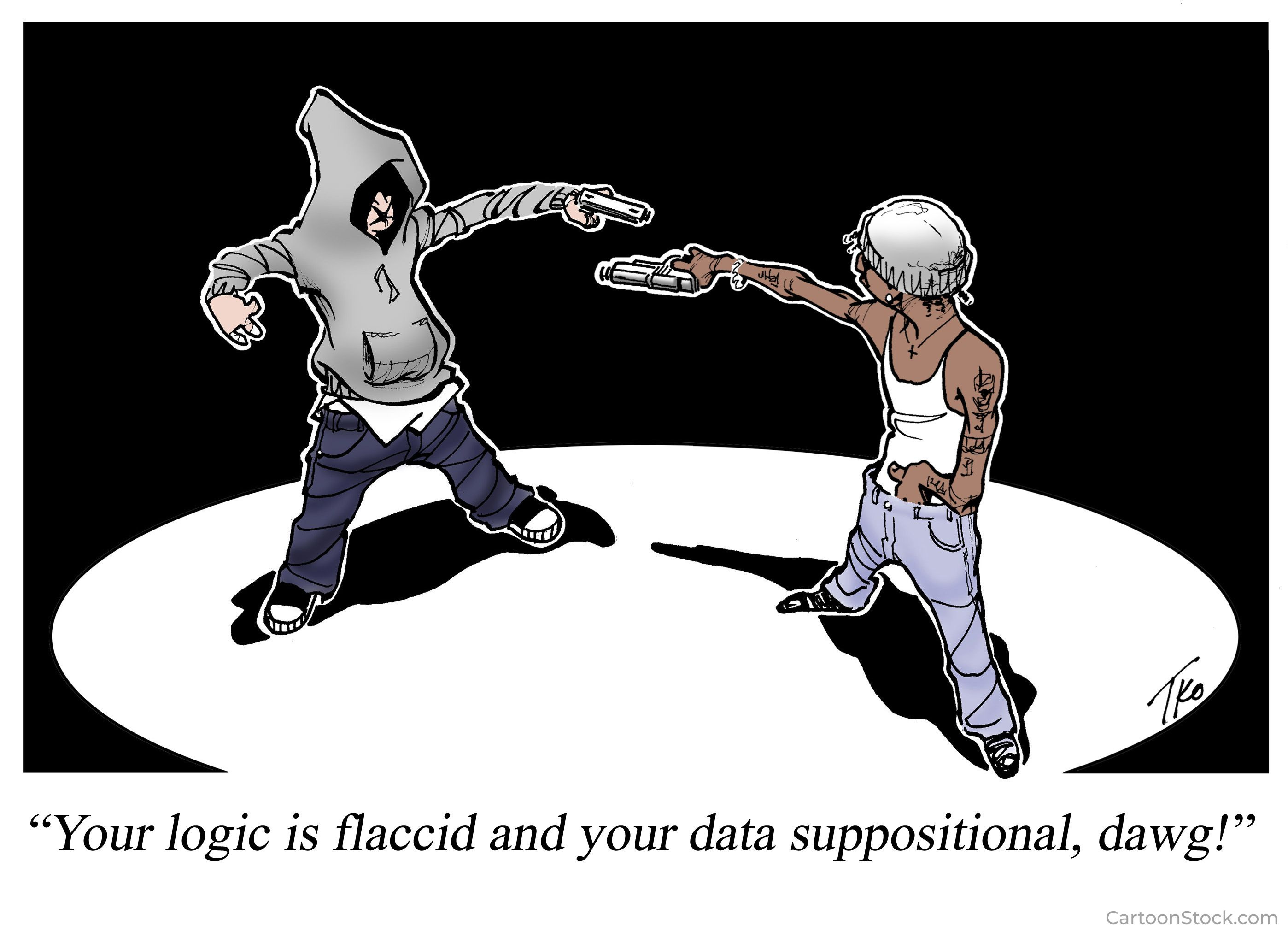
1. Appeal to Authority: “The Science Is Settled”
This is the big one. “97% of scientists agree.” “The IPCC says…” “The experts have spoken.” End of discussion.
It’s the secular version of “God said so.” Science doesn’t work by papal decree. Real science thrives on skepticism, replication, and challenge. History is full of “settled” consensuses that later collapsed: the geocentric universe, eugenics as sound policy, stress as the main cause of ulcers. Bloodletting is a great example.
Doctors historically bled patients based on the theory of humoralism (or humoral theory), which posited that health depended on a balance of four bodily fluids—blood, phlegm, yellow bile, and black bile. Illness was thought to be caused by an excess of one humor, specifically a surplus of blood (plethora), which was deemed the dominant humor.
This continued from the Ancient Greeks into the early 1800’s until it was disproven by germ theory and cellular pathology. During his final illness, George Washington was treated by blood letting, among other now known to be false theories of biology and medicine.
Climate science involves genuine uncertainties — equilibrium sensitivity, cloud feedbacks, regional impacts, the exact weighting of human versus natural factors. Many things claimed to be “Settled Science” in the realm of climate just a few years ago are now proving to be incorrect with new evidence and data. Pointing to expert bodies isn’t automatically wrong, but treating them as infallible prophets is. “The Science” is not a person you can debate; it’s a shield.
2. Moving the Goalposts: Eternal Doomsday Reset
The predicted apocalypse keeps getting new deadlines and new symptoms:
Polar bears were supposed to be nearly extinct by now.
The Arctic was supposed to be ice-free.
Island nations were going underwater.
We were promised no more snow in the UK.
When those predictions fail or underperform, the narrative quietly shifts to the next crisis: shrinking Greenland ice, “weird weather,” or tighter temperature targets that keep sliding. If you are in a discussion and you point out that there are more polar bears today than 30 years ago, the Climate True Believer will quickly move to another goalpost.
This isn’t science updating itself with better data. It’s rhetorical evasion. A specific, falsifiable claim gets replaced by something vaguer and harder to disprove. Every time reality gets too close, the goalposts sprint forward.
3. Anecdotal Fallacies: Today’s Weather = Climate Proof
“Record heat in Podunk today — climate change is real!”
Or the satirical flip: brutal blizzard hits and someone blames global warming.
Both are nonsense. Weather is not climate. Anecdotes are not data. One hot (or cold) day, one bad fire season, or one dramatic flood tells you almost nothing useful. Serious analysis requires long-term datasets, satellite records, peer-reviewed studies, and proper attribution — not Instagram photos of melting ice or your local heatwave.
I enjoy sarcastically blaming every cold snap on global warming precisely because it exposes how ridiculous the anecdotal game is.
Other Fallacies That Keep Showing Up
Straw Man: Painting all skeptics as people who deny the greenhouse effect or any warming at all, instead of engaging with real questions about sensitivity, adaptation, or policy trade-offs.
False Dilemma: “Either we go net-zero by 2035 or the planet dies.” No room for nuclear, adaptation, technological innovation, or cost-benefit analysis. This one is a favorite of politicians, as is the next fallacy.
Appeal to Fear: Distant, high-uncertainty catastrophic scenarios used to justify immediate, economically painful policies.
Ad Hominem: Labeling anyone who questions the narrative a “denier,” “fossil fuel shill,” or ignoramus — classic avoidance of the actual arguments.
The Bottom Line
If your case for urgent, radical climate action depends so heavily on logical fallacies, authority worship, and constantly shifting predictions, it is weak. A robust position welcomes scrutiny. It doesn’t need to hide behind “the science is settled” or demonize dissenters.
This isn’t about denying physics or observed warming. It’s about demanding intellectual honesty: treat climate as science, not as a faith. Bring data, acknowledge uncertainties, debate the actual numbers (sensitivity estimates, economic models, adaptation vs. mitigation), and argue in good faith.
True believers, bring your A-game next time. The conversation — and the planet — and the culture — would be better for it.
What fallacies have you noticed most often in climate debates? Drop them in the comments. Let’s keep it logical.
The fact that the baselines of CO2 and Temperature are arbitrary based on the ability to measure, not the optimal of either. That, couple with the fact that climate alarmist always goes from science to economics and ignores adaptation and evolutionary biology.
Oh and CO2 is a fertilizer.
I've dealt with everything you have and have the same frustrations. So I became a global warming advocate because it is happening but I think it is good. More here: https://www.polymathicbeing.com/p/the-climate-is-changing
Not necessarily a fallacy but when I suggested that climate change was possible but not manmade,
"Oh, that's convenient. If that's true than you don't have to do anything about it."