


The Constitution was built on a deliberate compact between the people and the states. What happens when significant portions of that compact are no longer accepted?
The Constitution was ratified by the states as a binding compact. The original 13 states consented through their legislatures. Every state admitted afterward explicitly accepted the same framework. This was never meant to be a temporary or easily discarded agreement.
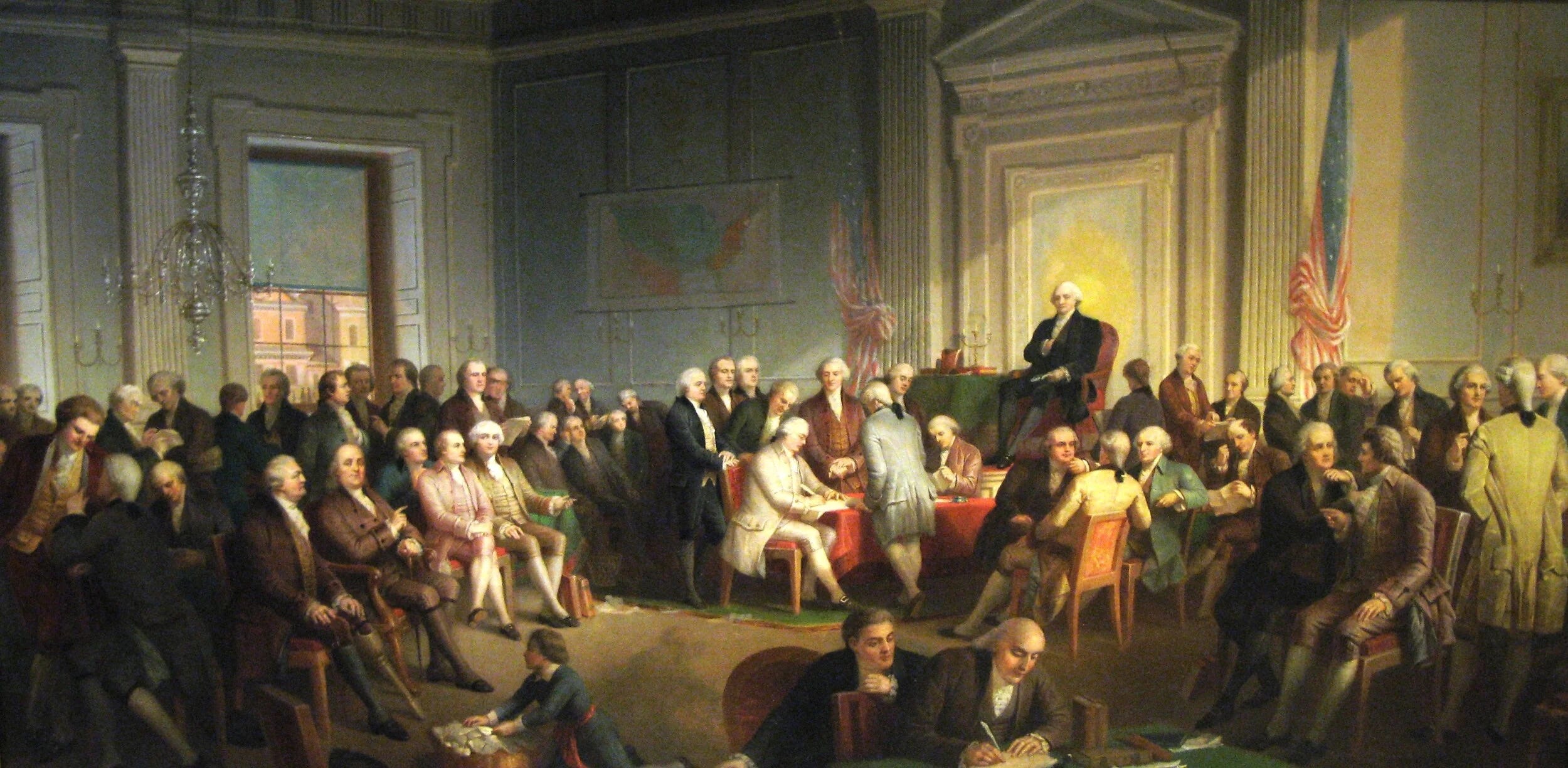
The Bill of Rights
The Bill of Rights was originally a restraint on the federal government. The 14th Amendment changed that by incorporating most of those protections and making them binding on the states as well.
Yet today we see sustained, deliberate resistance in multiple states to core Bill of Rights protections:
First Amendment (speech, religion, assembly)
Second Amendment (the current “assault weapon” cases are only the latest example)
Fourth, Fifth, and Fourteenth Amendment protections in criminal justice and regulatory contexts
When states treat the Bill of Rights as optional, they are rejecting a central part of the constitutional settlement.
Federal Supremacy and Enumerated Powers
The Constitution allocates certain powers to the federal government and explicitly excludes the states from exercising them. Immigration and border control are among the clearest examples of enumerated federal authority. At the same time, the Ninth and Tenth Amendments reserve all other powers to the people and the states.
This structure is deliberate. If a power is properly federal, a governor’s personal or political dislike does not override it. The state has no more authority to nullify that power than it does to ignore the Bill of Rights. Expressing disagreement is legitimate. Active resistance and nullification are not.
Governance Without Representation
The Framers designed the Senate to give the States direct representation in the federal government. Senators were chosen by state legislatures, not the people at large. This was intentional. It gave the states a powerful institutional voice to protect their sovereignty and check federal overreach.
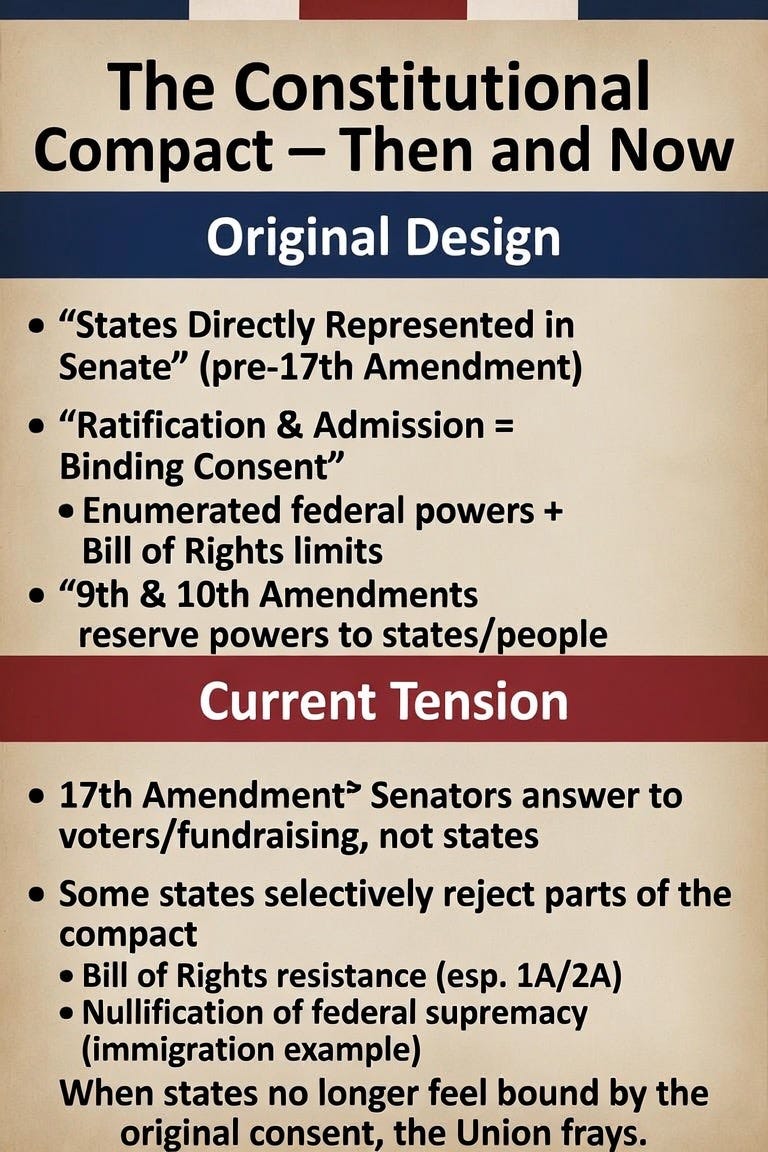
The 17th Amendment changed that. By making Senators directly elected by the people, it nationalized the Senate and largely severed the states’ formal institutional link to the federal government. State legislatures lost their direct leverage. Today, Senators no longer answer to the State at all. They answer primarily to fundraising, national party interests, and popular vote cycles in their state.
One might almost say the States now face governance without representation — a situation eerily reminiscent of the original colonial grievances against King George and Parliament. Ironically, all that might have been required to prevent the American Revolution was giving the colonies a meaningful voice in Parliament. Consider that in light of the States having no direct representation.
Whether one agrees with them or not, the roughly ten Blue States that are most aggressively resisting federal authority clearly do not feel they have meaningful institutional voices in a federal government that now holds large swathes of power. This situation fuels much of the current tension.
The Legal Foundation of the Constitution
It is worth remembering that the original 13 States had to ratify the Constitution in order for it to binding on them. And then every state admitted after the original 13 was required to formally accept the Constitution as a condition of admission. Through their enabling acts and admission resolutions, which are legal and binding, each new state explicitly consented to the constitutional compact and agreed to be bound by it. This was not a casual formality. It was a positive, binding act. The state legislature and people affirmatively chose to join the Union under the terms set by the Constitution.
The Deeper Problem
The entire point of the Constitution is that certain foundational laws, processes, and protections of individual rights are taken off the table. The government, federal and state, is constrained by those limits. And the municipal governments are bound by the State Constitutions. Every layer of our Federal system has a legally binding structure that they are obligated to.
When those governments overstep, we have peaceful mechanisms — elections, legislation, federalism, the courts, and petition for redress of grievances — to enforce the Constitution.
As President Coolidge observed on the 150th anniversary of the Declaration of Independence, the genius of the American system was placing certain rights beyond the reach of government. The Constitution is not a grant of unlimited power to majorities or bureaucracies. It is a deliberate restraint — a document in which We the People removed foundational rights and principles from ordinary political control, and the States agreed to this framework.
The real danger we face today is not simply rogue bureaucrats or overreaching federal agencies. It is the growing willingness of states themselves to nullify portions of the Constitution and ignore enumerated federal powers when it suits them. Whether it is the Bill of Rights or clear areas of federal supremacy such as immigration, some states are effectively declaring that parts of the constitutional compact no longer apply to them.
This is far more corrosive than simple policy disagreement. When states, which were parties to the original compact, begin selectively rejecting the Constitution while still claiming its protections and benefits, they undermine the very foundation of the Union. The peaceful mechanisms designed to resolve such disputes are being bypassed. That path leads not to reform, but to constitutional erosion and eventual fracture.
Observations from the Late Republic
#Observations #LateRepublic #Federalism #TheConstitution
Further Reading
The Federalist Papers (especially Nos. 10, 39, 45, 51, and 62)
Randy E. Barnett, Restoring the Lost Constitution: The Presumption of Liberty
Akhil Reed Amar, The Bill of Rights Primer
Prior to the 16th amendment the federal government could tax the people directly (article I section 9): "No Capitation, or other direct, Tax shall be laid, unless in Proportion to the Census or enumeration herein before directed to be taken."
Such a tax had to be "in proportion to the census or enumeration herein before directed to be taken." I'm not a legal scholar, but I think that it means that the tax had to be the same per person. That means people with no income or wealth would be unable to pay. If everyone is supposed to pay the same, but some can't, how do you tell the people who ARE paying that those who can't pay have no penalty for not paying? And what do you do with those who can't pay? Forced labor to pay the debt? If all are not paying, is the tax then in violation of the constitution? Meaning if you CAN'T collect from everyone, you can't collect from anyone? Congress did try to implement an income tax before the 16th, but it was ruled unconstitutional. But this is all speculation on my part, based on my possibly flawed understanding of what the "unless" clause in that paragraph means.
Per-person fixed-fee is what I think we should have. With one caveat: if an adult can't pay, they either serve a prison term (community service/forced labor) to pay the debt, OR let them sell their vote to another person in their voting area (same congressional district). We'd have to allow 2 votes per person (1 for each tax year) for the House of Representatives, so if you can't afford 1 year's worth of taxes, you can sell that vote but can cast the other one yourself. We could allow the buyer of the vote to designate someone to cast the vote (so a working spouse can pay the non-working spouse's tax bill, and allow them to cast their vote), as long as that person is eligible to vote in the same district. This way, only people who pay the cost of government are allowed to choose who can run the government. That's why we're in the mess we're in now: people who work for a living are outnumbered by those who vote for a living at the polls.
As long as there is no meaningful penalty for violating the people's rights, politicians will continue to do it because there are voters who approve. For example, during the "gay marriage" debate, I met at least one person who specifically said that the government's job was to impose his sense of morality on everyone. People who approve of a particular form of oppression don't see it as oppression, they see it as "how it should be", and others are wrong for disagreeing. Politicians violate our rights because their voters approve of the violation. Supposedly, our recourse is to vote them out of office. But that doesn't work. When you have majorities in numerous districts that approve of government stealing your money so it can be given to them as "welfare", or who want certain speech/published works banned, etc. they'll never vote them out. We need a change in the Constitution that voting for a bill later found to be unconstitutional means the politician violated their oath of office, and they are automatically removed from office and barred from holding any federal office of any kind ever again (and kill their pension, etc.). They should be terrified of being left destitute every time they vote.
As things stand now, politicians vote a bill into law that violates the people's rights. The people have to pay for lawyers to fight against it for a decade or so to get the case before SCOTUS, while the politicians use taxes to pay the lawyers that fight to uphold it. SCOTUS rules that law unconstitutional and to be stricken from the books and no longer enforced. The politicians then change the name on the original bill, and pass it again with the text unchanged (IIRC, New York did this back in the early 1980s). And the cycle repeats. I'm in favor of the death penalty for politicians who violate their oaths of office like this, but I'll settle for their immediate removal from office, becoming ineligible to hold office (elected, appointed, hired, consulted, or volunteered), and loss of further government benefits (no payments of any kind, no security, nothing).