


Introduction
Most Americans today understand the growing tension in our republic through a simple, dramatic frame: the “Establishment” versus “the People.” It is a compelling story, and it captures something real. Yet it is also too recent and too shallow.
For decades after World War II, large majorities of the American public actually liked much of what the emerging Fifth Branch delivered. We appreciated the competence, the stability, the technological edge, and the sense of national purpose it helped provide. Many of its institutions earned genuine respect and gratitude.
What we disliked, often intensely, were the pieces that felt partisan, overreaching, or personally intrusive. Conservatives frequently cheered when the security apparatus targeted anti-war activists and other perceived anti-state elements, while liberals were outraged when the same tools were later turned against environmentalists or causes they supported. In other words, for a long time we were less troubled by the existence of the Fifth Branch than by whose interests it appeared to serve at any given moment.
It is also true that the modern world — dramatically smaller in both distance and time, yet far more complex due to technology, global interdependence, and population growth — requires more government than the America of the 1820s. The challenge is not whether some form of administrative capacity is necessary, but whether that capacity has grown beyond constitutional bounds and become insulated from meaningful accountability to the sovereign citizenry.
Only more recently has a deeper realization taken hold: the problem is not merely that the administrative state sometimes acts in a partisan fashion, but that it has become structurally unaccountable to the sovereign citizenry — the Fourth Branch — regardless of which party holds power.
Ironically, the emerging Fourth Branch coalition pushing back against this unaccountable elite is itself remarkably diverse. It is not simply conservatives versus liberals. We see it in the unexpected alignment between figures like Donald Trump and Robert F. Kennedy Jr., among many others — a broad, cross-ideological reassertion of popular sovereignty against a permanent administrative class that increasingly acts as if it alone knows what is best for the country.
What began as emergency tools during existential crises gradually evolved into a self-perpetuating shadow government that now administers large portions of national life with only limited real oversight from elected officials or the people themselves.
This is the story of how that transformation occurred. It is also the story of how the Fourth Branch has begun to react with growing anger and a populist counter-revolution. History, particularly the late Roman Republic, reminds us that when a republic’s elites and its sovereign people begin to view each other as adversaries rather than partners in self-government, the consequences are rarely gentle.
The Golden Age Peak (1945–mid-1960s)
In the two decades following World War II, America stood as the undisputed hyperpower of the known world — the first nation since Rome after the destruction of Carthage to dominate its entire sphere so completely. The United States had defeated two of the most formidable military machines in history, rebuilt its allies and even its former enemies, and presided over an era of unprecedented prosperity and technological progress.
For the broad mass of the American people, this was a time of extraordinary trust in institutions. The federal government had delivered victory abroad and rising living standards at home. The military was respected, industry was innovative, and the administrative apparatus that managed demobilization, the Marshall Plan, and the early Cold War seemed competent and largely benevolent.

Crucially, it was not yet obvious to most citizens that the bureaucracy was beginning to develop a life of its own — gradually becoming less responsive to constitutional and political controls. Most Americans still viewed the growing administrative state as an extension of elected government rather than an independent force. The Fourth Branch — the sovereign citizenry — largely deferred to this emerging Fifth Branch, confident that it remained accountable and served the common good.
This was the Golden Age consensus: a powerful but still apparently accountable partnership between the people and their institutions.
The Emergency Foundations
That consensus had its roots in the emergency structures built during World War II — the largest and most complex mobilization in human history.
To fight a global war, America created an unprecedented administrative apparatus. Twelve million men were mobilized into uniform. Entire industries were converted to war production. The Office of Strategic Services (OSS) pioneered modern intelligence operations. The War Department grew into what would become the Department of Defense. The Pentagon itself became the physical symbol of centralized command and control.
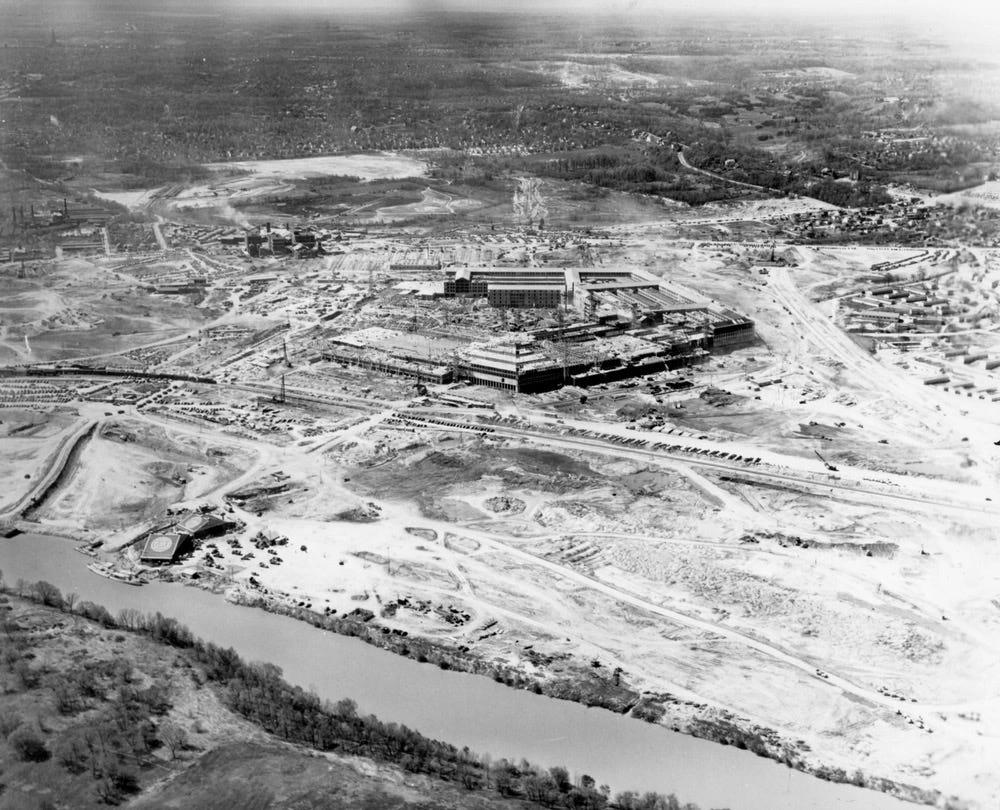
In the Pentagon, and surrounding offices in DC, a vast network of agencies coordinated manpower, logistics, procurement, and scientific research on a scale never before attempted.
These structures were born of necessity. They were temporary tools designed to win an existential conflict. When the war ended, however, most of them were not dismantled. Instead, the Cold War provided a new justification for their permanence. What had been emergency powers gradually hardened into standing institutions. The administrative state that began as a wartime expedient became a permanent feature of American governance.
By the time Eisenhower left office, the foundations of the Fifth Branch were firmly in place. The question no one fully answered was whether a republic could indefinitely sustain such concentrated, unelected power without it eventually slipping beyond the control of the sovereign citizenry.
Eisenhower’s Warning
No one was better positioned to see the danger than Dwight D. Eisenhower.
He led the most powerful military force in history and the Great Crusade to overcome Hitler. He helped orchestrate the vast industrial mobilization that defeated Nazi Germany and Imperial Japan, and then served eight years as President. He knew the machine from the inside — its necessity, its power, and its momentum.
In his Farewell Address on January 17, 1961, Eisenhower delivered one of the most prescient warnings in American history. He spoke of the “military-industrial complex” — the conjunction of an immense military establishment and a large arms industry — and cautioned that its “total influence — economic, political, even spiritual — is felt in every city, every statehouse, every office of the federal government.”
He continued:
“In the councils of government, we must guard against the acquisition of unwarranted influence, whether sought or unsought, by the military–industrial complex. The potential for the disastrous rise of misplaced power exists and will persist.”
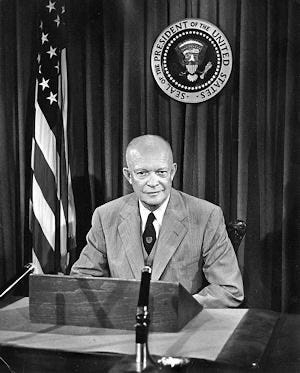
Eisenhower was not a critic of strong national defense. He was its most successful practitioner. His warning was not born of ideology, but of hard-won experience. He understood that the emergency structures built for existential war had become permanent features of American life. He saw how easily concentrated power, even when created for legitimate purposes, could develop its own institutional interests and gradually slip beyond the control of the sovereign citizenry.
That address marked a quiet but profound turning point. For the first time, the man who had helped build the modern national security state publicly acknowledged that the emergency structures of war and Cold War were hardening into something permanent — a Fifth Branch developing its own momentum and interests.
Americans were beginning to feel the first cracks in the Golden Age consensus. The late 1950s and early 1960s would see the start of a long unraveling: growing unease with centralized power, cultural rebellion, loss of trust in institutions, and the first stirrings of what would eventually become a broad populist pushback from the Fourth Branch. Eisenhower had sounded the alarm. The Republic did not fully heed it.
The Expansion – Two Parallel Tracks
Once the foundations were laid, the Fifth Branch did not remain static. It expanded along two parallel but increasingly intertwined tracks, each feeding the other.
The foreign and national security track was the most dramatic. What began as the wartime Office of Strategic Services (OSS) rapidly evolved into a permanent, sprawling intelligence apparatus. The Central Intelligence Agency, established in 1947, quickly became the centerpiece of an ever-growing web of intelligence agencies, covert networks, black budgets, and affiliated organizations. Over time, the CIA and its sister agencies developed deep institutional entanglements with the State Department, USAID, and a vast array of contractors and cut-outs. This created a self-sustaining ecosystem that operated with high levels of secrecy, minimal congressional oversight, and its own independent sources of funding.
At the heart of this track sat the Pentagon. The wartime military had been enormous — over 12 million personnel in June 1945 — yet it was led by roughly 2,000 flag officers, a ratio of about one flag officer for every 6,000 other ranks. By 2025, according to USAFacts.org, the total military force (active and reserve) stood at roughly 2.1 million personnel, with only about 1.3 million on active duty. The number of flag officers was around 838 on active duty. This produced a dramatically tighter ratio of approximately one flag officer for every 1,500 other active-duty ranks — roughly four times the number of flag officers per capita as during World War II. The command structure had become dramatically more top-heavy even as the force itself contracted. This bloat extended deep into a vast civilian bureaucracy and an enormous network of defense contractors whose profits depended on sustained high levels of spending.
The domestic security track followed a similar pattern of growth and entrenchment. J. Edgar Hoover had already built the FBI into a powerful, centralized institution with vast surveillance capabilities and secret files that gave him leverage over politicians on both sides of the aisle. Nixon’s declaration of the War on Drugs in 1971, followed by Reagan’s dramatic escalation in the 1980s, poured federal money, grants, and authority into local law enforcement. Asset forfeiture programs, militarized policing, and federal oversight turned much of American law enforcement into an extension of national policy rather than purely local authority. The process reached a new level after 9/11 with the creation of the Department of Homeland Security and its network of fusion centers. By the time the domestic security state was fully operational, it had achieved something the KGB could only dream of: vast reach, sophisticated technology, and deep institutional power — all built with the full blessing of both political parties and the appearance of constitutional legitimacy.
These two tracks did not stay separate for long. Intelligence capabilities increasingly bled into domestic surveillance, regulatory agencies grew intertwined with national security priorities, and the entire apparatus became mutually reinforcing.
Surrounding and enabling both tracks was a vast regulatory bureaucracy. Congress, often deliberately, passed broad and vague legislation, leaving the executive branch and its agencies to “fill in the details” through thousands of pages of rules and regulations. This abdication of legislative responsibility allowed the administrative state to effectively write its own law — with the force of statute but without the accountability of elected representatives.
None of this expansion would have been sustainable without a dramatic and permanent increase in the federal government’s fiscal power. As the following chart illustrates, federal spending as a share of GDP surged during World War I, receded somewhat afterward, then exploded again during the Great Depression and World War II. Critically, after 1945 it never returned to pre-war levels. Instead, it stabilized at a much higher baseline, creating the steady flow of revenue and borrowing capacity needed to fund a large, permanent administrative apparatus.
Federal spending and taxing over 1900-2012
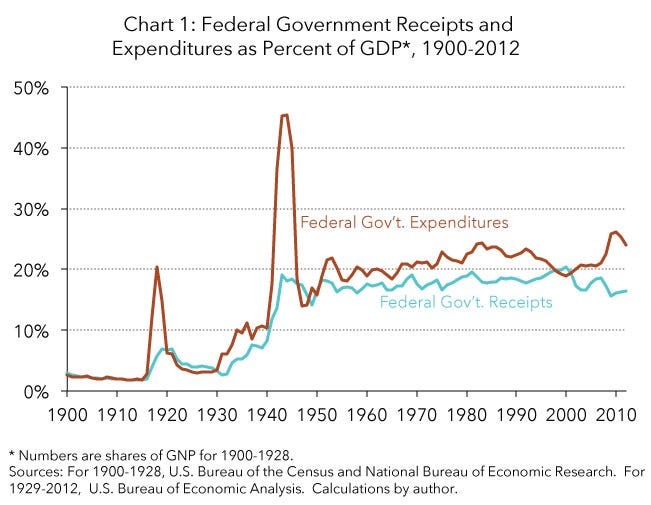
Follow the money, and the addiction becomes clear. Without this permanent elevation of federal spending and taxation, the Fifth Branch — with its intelligence agencies, regulatory bodies, domestic security apparatus, and vast network of contractors — could never have become self-sustaining.
Bipartisan Maintenance
The expansion of the Fifth Branch was not the work of one party or one ideology. Both Democrats and Republicans, when in power, actively maintained and enlarged the apparatus they inherited.
Richard Nixon imposed wage and price controls, ended the gold standard, created the Environmental Protection Agency and Occupational Safety and Health Administration, and formally declared the War on Drugs. Jimmy Carter oversaw the creation of the Department of Education, which allowed the federal government to insert itself deeply into local education policy and funding. Ronald Reagan, despite campaigning against big government, dramatically escalated the War on Drugs, expanded federal law enforcement funding and asset forfeiture, and continued strengthening the national security apparatus. Each side criticized the other’s excesses while protecting and growing the parts that aligned with their priorities.
This pattern of bipartisan maintenance became almost reflexive across decades. New agencies were created, budgets grew, and the revolving door between government, contractors, and aligned institutions spun ever faster. The administrative state developed its own institutional inertia — difficult for any single administration or Congress to reverse.
By the early 21st century, the Fifth Branch had metastasized. The creation of the Department of Homeland Security after 9/11, the open-ended Global War on Terror, and the passage of the Patient Protection and Affordable Care Act (PPACA) marked a qualitative leap. These initiatives, along with the rapid expansion of surveillance capabilities and regulatory reach, produced an administrative apparatus that no longer saw itself merely as an instrument of elected government. Instead, it increasingly operated as its own entity — a legitimate and independent shadow government with its own continuity, priorities, and sense of rightful authority.
The Result: A Shadow Government
By the early 21st century, this transformation was largely complete. The administrative apparatus had become something qualitatively different from the temporary wartime structures of the 1940s or even the Cold War institutions of the 1950s. It now functioned as a shadow government — not in the conspiratorial sense, but in the structural one: a parallel system of power that operated with its own continuity, incentives, and sense of legitimate authority.
At its core were entrenched bureaucrats who viewed themselves as the true stewards of national policy. Many possessed advanced degrees from elite institutions and carried the quiet conviction that their technical expertise entitled them to make decisions that elected officials and ordinary citizens were ill-equipped to understand. “I have a degree from Harvard” often carried more practical weight than any election, constitutional check, or clear competence.
Layered on top of this was a vast military and intelligence network that had made itself increasingly opaque to meaningful review, audit, or control. Black budgets, classified programs, and revolving-door relationships with major contractors created entire domains of policy that even senior members of Congress struggled to oversee. The same dynamic extended into domestic security and regulatory agencies, where complex rules, guidance documents, and enforcement discretion allowed officials to shape outcomes with little direct accountability to voters or their elected representatives.
The result was a self-perpetuating system that administered large swaths of American life — healthcare, education, finance, energy, transportation, border security, surveillance, and more — with only limited real oversight from the constitutional branches or the sovereign citizenry. The Fifth Branch had become its own entity, largely independent of the very government it was nominally part of.
The Permanent Government Expert
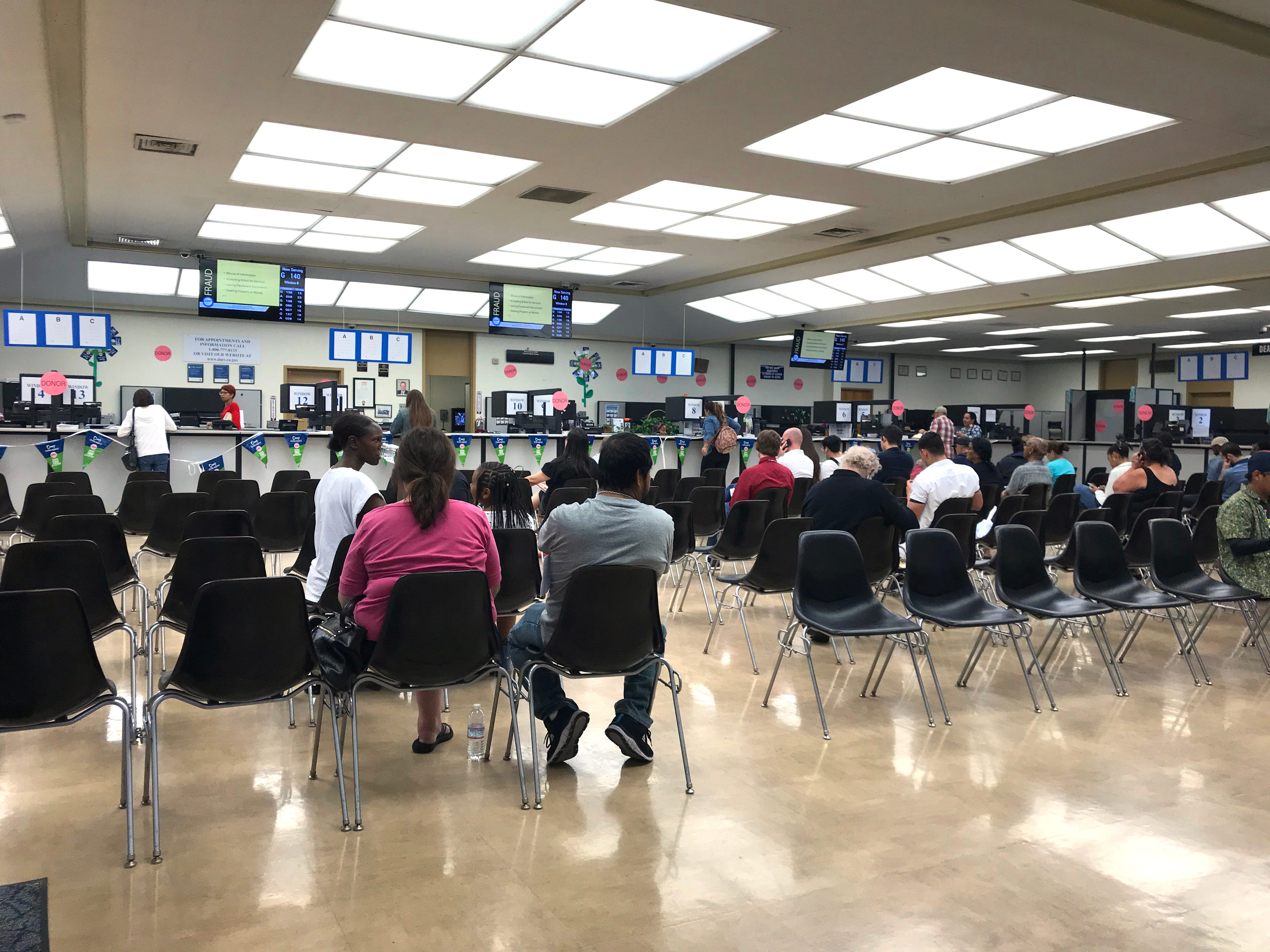
A defining feature of the maturing Fifth Branch has been the rise of the “permanent government expert” — the long-serving insider who accumulates institutional knowledge, networks, and influence that often outlast multiple administrations and elected leaders.
J. Edgar Hoover remains the clearest archetype. For nearly five decades he shaped the FBI into a powerful, centralized institution with vast surveillance capabilities and secret files that gave him leverage over politicians on both sides of the aisle. Later figures followed similar paths in different domains: highly competent, deeply embedded, and extraordinarily difficult to dislodge. Colin Powell, a career soldier who rose to the highest levels of the national security apparatus, embodied the same archetype in the military realm. So too did Anthony Fauci in public health. Each represented a class of expert whose tenure and institutional gravity often exceeded that of the presidents they nominally served.
Friedrich Hayek warned us about exactly this danger. In works such as The Road to Serfdom and The Fatal Conceit, he argued that the belief in centralized expert knowledge — what he called the “pretense of knowledge” — is one of the great intellectual errors of the modern age. No small group of planners, no matter how intelligent or well-intentioned, can possess the dispersed, local, and tacit knowledge held by millions of individuals acting in a free society. This is precisely the vision the Founders had in mind when they placed their ultimate trust in the Fourth Branch — an educated, armed, and self-reliant citizenry — rather than in any permanent class of experts.
The permanent government expert thus becomes both symptom and accelerator of the Fifth Branch’s growth. Competence is real; the danger lies in the unchecked autonomy and self-perpetuation that follow. Over time, these figures and the institutions they inhabit stop merely advising the Republic — they begin to manage it.
The Citizens React – And the Fifth Branch Responds
As the administrative apparatus became more entrenched and insulated from accountability, large segments of the Fourth Branch — the sovereign citizenry — grew increasingly angry and alienated.

A key turning point came in the early 21st century. By roughly 2000 it was no longer obvious that the bureaucracy retained the competence it had shown during World War II and the Golden Age. By 2010, many citizens had become convinced that the Fifth Branch was both authoritarian — imposing policies and cultural changes with little regard for public consent — and demonstrably incompetent.
Citizens grew infuriated by what they saw as elite overreach and incompetence. Concrete examples included:
Regulating inexpensive and reliable incandescent lightbulbs out of existence in favor of more expensive alternatives
Heavily regulating health care while costs continued to skyrocket and overall health outcomes stagnated or declined
Appearing to prioritize big banks and financial institutions over struggling citizens during the 2008 financial crisis
Fighting a 20-year Global War on Terror that was never clearly won or lost, yet proved enormously profitable for the military-industrial complex
This combination of perceived overreach and failure fueled a broad populist counter-revolution, visible in movements ranging from the Tea Party to widespread skepticism of official narratives to the MAGA phenomenon.
Observers of the Late Roman Republic will recognize elements of this same dynamic. When the Gracchi brothers gave voice to popular grievances against an increasingly self-serving senatorial elite, the response was not meaningful reform but political violence, legal manipulation, and the breaking of long-standing norms. Lawfare — the weaponization of legal and political institutions — became a tool to protect elite power rather than serve justice.
A parallel pattern is observable today. The Fifth Branch has responded to the Fourth Branch’s pushback not with humility or course correction, but with greater insulation, selective enforcement of the law, cultural policies sharply at odds with the values and common sense of much of the citizenry, and the continuation of undeclared wars and immigration approaches that appear to serve institutional or ideological interests more than the common good of the Republic.
This escalating cycle of reaction and counter-reaction reveals a dangerous fraying of the implicit social contract that once held the Republic together. History shows that when a republic’s elites and its sovereign citizenry begin treating each other as adversaries rather than partners in self-government, the path forward becomes precarious.
Conclusion
The story of the Fifth Branch is not one of sudden betrayal or a single villainous administration. It is the story of a long, incremental, and strikingly bipartisan transformation. What began as emergency tools to win a world war and contain a global ideological threat gradually hardened into a permanent administrative apparatus — a shadow government that now wields enormous influence over American life with only limited real accountability to the sovereign citizenry.
Eisenhower saw the danger clearly. Hayek explained the intellectual error that made it possible. History, particularly the late Roman Republic, shows us where such dynamics often lead. When elites become insulated from the people they are meant to serve, when legal and political institutions are used more to protect power than to deliver justice, and when the citizenry begins to view its own government as an adversary, the implicit social contract that holds a republic together begins to fray.
The Fourth Branch — the educated, armed, and self-reliant citizenry the Founders placed at the heart of the American experiment — is now reacting. The populist counter-revolution we see today is not merely partisan anger or a reactive desire to return to a former Golden Age; it is a structural reassertion of popular sovereignty against a permanent elite that has grown accustomed to ruling rather than serving.
Whether this reaction can restore balance, or whether it will accelerate the very cycle of mistrust and overreach that produced it, remains to be seen. What is clear is that the Republic cannot long endure if its elites and its sovereign people continue to treat each other as enemies. The lessons of the Late Roman Republic are not comforting, but they are instructive.
The path forward will not be simple. It will require honesty about how we got here, restraint on all sides, and a renewed commitment to the Founders’ vision of a republic in which the ultimate power resides not in any permanent bureaucracy, but in the citizenry itself.
Further Reading
On the dangers of centralized expert planning: Friedrich Hayek, The Road to Serfdom and The Fatal Conceit.
On Eisenhower’s warning and the military-industrial complex: Dwight D. Eisenhower’s Farewell Address (January 17, 1961) and Eisenhower in War and Peace by Jean Edward Smith.
On the scale of American industrial mobilization and grand strategy in World War II: Freedom’s Forge: How American Business Produced Victory in World War II by Arthur Herman and Winston S. Churchill, The Second World War (especially the volumes covering American production and logistics).
On the Great Depression and the rise of the administrative state: Amity Shlaes, The Forgotten Man: A New History of the Great Depression.
On the growth of the administrative and regulatory state: “A Short History of Government Taxing and Spending in the United States” by Michael Schuyler, Tax Foundation.
On the origins and expansion of the intelligence community: The Office of Strategic Services – CIA Official History.
Observations from the Late Republic
#Observations #FifthBranch #LateRepublic #AdministrativeState #ShadowGovernment #FourthBranch #EisenhowerWarning #Hayek #CitizenSovereignty
I'm starting a serial discussion about authority, particularly how it evades accountability by nature, as well as asking the question "Is this what we originally signed up for?".
Your article is a prime example of how authority can very easily run amok and lose meaningful accountability.
https://jabster.substack.com/p/on-authority