


Not a travelogue, but the origin, evolution, and practical implementation of one of the most famous pistol drills used for training and combat today.
Origin
Retired Marine Colonel Jeff Cooper was one of the best teachers of pistol and rifle craft seen in the modern era. He built the Modern Technique of the Pistol through experience at the Leatherslap competitions in Big Bear, CA. He wrote the four rules of gun safety that almost every instructor now recites. He gave us the color code for combat mindset, the Scout Rifle, the carry conditions, and a pile of other ideas so common that a lot of people teach them without ever saying his name.
In the early 1970’s, Cooper created the Mozambique Drill based upon a real life engagement in Mozambique involving Rhodesian mercenary Mike Rousseau and an unidentified insurgent at the airport in Lourenço Marques, now Maputo. Rousseau came around a corner and was confronted at short (approximately 10 paces) range by a large FRELIMO insurgent armed with an AK-47. Rousseau fired two rounds from his Browning Hi-Power to center of mass on the insurgent, which did not stop him. So, Rousseau went for a head shot to end the situation, but actually missed the T zone (which is the triangle running from the center of the lips to edges of the eyebrows) and hit the bottom of the throat. However, the shot severed the spinal cord and ended the fight.
Cooper developed this into the Mozambique Drill and began teaching it at Gunsite in the 1970’s. Other shops later called it the Failure to Stop Drill. LAPD SWAT officers Larry Mudgett and John Helms took it home from Gunsite in 1980 and asked to teach it under that blander name. The Marine Corps still runs a Failure to Stop string in rifle tables.
I much prefer Mozambique Drill to the colorless and bland “Failure to Stop”. Call it what it is, a Rhodesian fighting communist guerrillas in Mozambique originated the method, Cooper codified it: The Mozambique Drill.
How-To: As Taught by Colonel Cooper
Col Cooper wrote about this in Cooper’s Commentaries Volume 4, Number 8:
“Upon analysis, it seemed to me that the pistolero should be accustomed to the idea of placing two shots amidships as fast as he can and then being prepared to change his point of aim if this achieves no results. Two shots amidships can be placed very quickly and very reliably and they will nearly always stop the fight providing a major-caliber pistol is used and the subject is not wearing body armor.
“However, simply chanting ‘two in the body, one in the head’ oversimplifies matters, since it takes considerably longer to be absolutely sure of a head shot than it does to be quite sure of two shots in the thorax. The problem for the shooter is to change his pace, going just as fast as he can with his first pair, then, pausing to observe results or lack thereof, he must slow down and shoot precisely. This is not easy to do. The beginner tends to fire all three shots at the same speed, which is either too slow for the body shots or too fast for the head shot. This change of pace calls for concentration and coordination which can only be developed through practice.”
It’s not as simple as “two to the chest, face gets the rest”, although I’m also not going to argue with the Dalai Lama ;-)

Practical Implementation in Training
The Mozambique Drill, as typically taught today, is a fast, controlled pair to the A Zone of the target, a fast assessment of whether that stopped the target, followed by an aimed shot to the T Zone. Combine that with some well understood defensive gun use statistics and we get the following based upon starting the Drill drawing from concealment:
Using a standard training or competition target, such as a TQ15, IDPA, or IPSC target. Pick one target and stick with it every time.


Set the target on a target stand between 5 and 7 yards distant.
Set a shot timer with a random delay and no par time.
When the shot timer beeps, the shooter draws from concealment and fires a rapid, controlled pair of shots at the A Zone then transitions to the head and fires a single, precise shot to the T Zone of the target.
The first shot should happen at less than 2 seconds, second shot with a rapid split (.25 to .3 seconds), both should be in the A Zone
The third shot to the T Zone, ideally, happens in less than 3 seconds, but this will depend upon the length of time to complete the first two shots. Don’t rush the 3rd shot chasing times, get it right.
Evaluate the shot impacts and review the times of each shot.
If your range does not allow you to draw from the holster, then train from the compressed horizontal position or the low ready position.
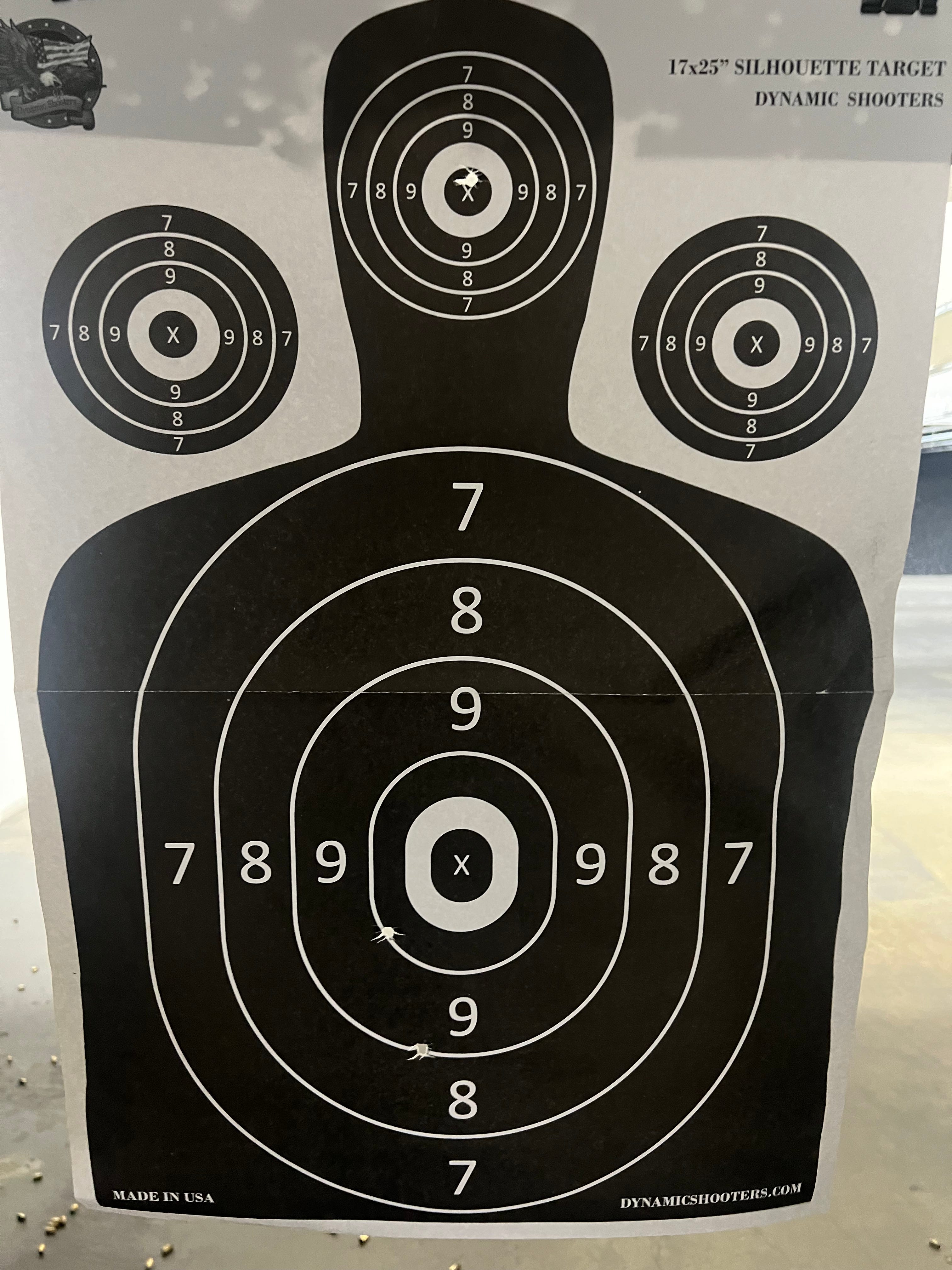
This is what it looks like on the target. This target was at 7 yards. My pistol was in a concealed holster and I was using a shot timer set on delay. Yes, the first two rounds are not a perfect double tap. But they happened at 1.8 and 2.08 seconds and the head shot happened at 3.06 seconds per my notebook from that day. This is not a full-size target, it’s about 75% of full-size. And it was in a low light indoor range without a weapon light.
Bottom Line is that the Mozambique Drill was developed based on real life experience. Cooper and Gunsite taught it. LAPD SWAT carried it into American police work as the Failure Drill. Marines still use the Failure to Stop idea on the rifle range. Most serious pistol schools put it next to the Bill Drill, which is a different problem and a later article.
If you carry a pistol for self-defense and you are not running Mozambique on a timer, you are practicing a story about self-defense. Two in the body, look, one in the head. Slow the third shot down until it is where Cooper said it had to be.
Modern Minuteman
Practical preparedness for everyday citizens.
Low-profile. Reliable. Quiet competence.
#Minuteman #EDC #Training #Preparedness #Mindset
All Modern Minuteman posts
Further Reading
Sheriff Jim Wilson, “The Mozambique Drill: A History and How To,” Shooting Illustrated
Pew Pew Tactical, “Mozambique Drill: [How-To] Better Your Shooting Skills”
Jeff Cooper, Cooper’s Commentaries, Vol. 4, No. 8 (you’ll have to search for this, I only found it physically)