


I’ve been watching the great “how dare you use AI” panic with a cigar in one hand and a growing sense of amusement in the other. Whiskey in yet another hand cause I’m a fourth dimensional critter like Dick Seaton and the Skylark crew ran into.
Last week I read a long Substack piece that spent 2000 words confidently declaring the author could spot AI writing from a mile away. No real method, no examples, no data. There was just paragraph after paragraph of “I can tell. I always know.” It was the literary equivalent of a guy at the range saying his gut tells him exactly where the bullet is going to hit.
So I decided to run an experiment.
I dug up something I wrote years ago, before ChatGPT, Claude, or any of this generative stuff existed. It was a straightforward piece about a massive storm hitting Western Washington. 100% human. Typed by me, edited by me, no AI anywhere near it. I pasted it into one of the popular “trusted” AI detectors.
Result? 65% AI-generated.
The tool even offered to “humanize” it for me. For a fee, of course.
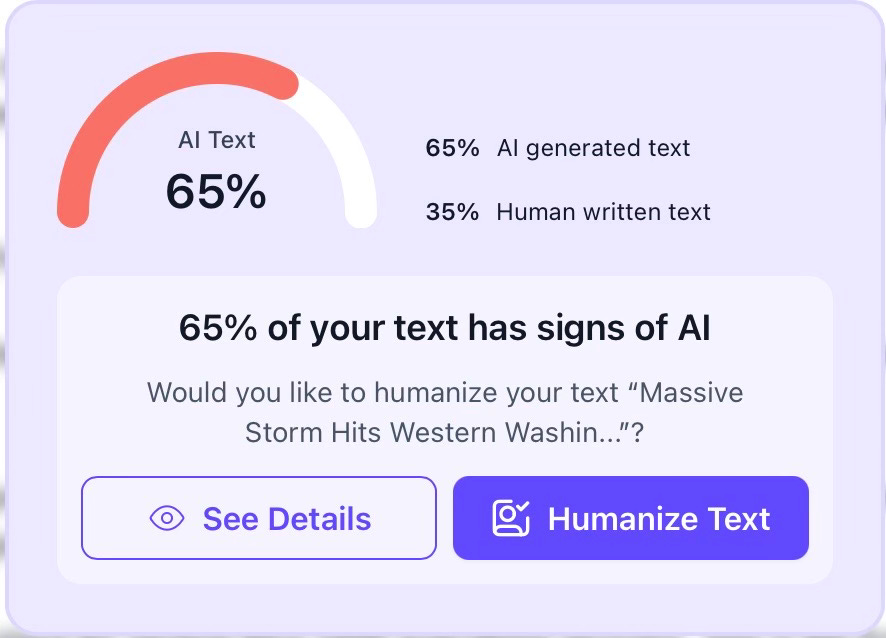
That’s when I started laughing.
These detectors aren’t catching AI. They’re mostly catching competent, clear, structured prose. The kind we drilled into kids in high school with Strunk & White: tight paragraphs, logical flow, active voice, no unnecessary fluff. If I still had my old 5-paragraph essays from my 1980’s English classes, I’d bet my entire cigar budget they’d all score 70-90% AI. Same with big chunks of Robert E. Howard’s Conan stories. Howard’s stories were muscular, rhythmic pulp writing with verbose sensory descriptions and consistent energy. Detectors would flag it as synthetic in a heartbeat.
Side note: My own pulp fiction is strongly modeled after Howard and “Doc” Smith’s style. It’s probably flagged 9000 ways from Sunday as AI by now.
One pattern I’ve noticed that does feel like a more reliable tell, at least for now: the overuse of em dashes. They show up constantly across pretty much every generative model I’ve seen. Technically they’re a valid way to handle complex ideas in a single sentence, but humans rarely use them other than in very formal writing. Our high school English teachers never taught us to use them, and if we did we generally got marked down. More importantly, em dashes tend to break the visual rhythm and beauty of prose on the actual page. It’s not just the words — it’s how the text looks to the eye. AI doesn’t really grasp that aesthetic dimension yet.
Meanwhile, the same tools that scream “AI!” at clean human writing are happily sold alongside “humanizer” services that add random contractions, sentence fragments, and quirky transitions so your text can dodge the very same algorithms. The humanizer tools are not creating beautiful, human prose. They are creating crap and you’re paying for the crap. It’s a perfect self-licking ice cream cone. Create the fear, sell the solution, repeat.
I get the unease. Writing feels personal. When something new comes along that can produce decent text at scale, a lot of people reach for the pitchforks and start talking about “soul” and “authenticity.” But the detectors prove they can’t even reliably separate last decade’s careful human work from machine output.

AI is here. It’s not going away. The smart move isn’t to pretend you have a magical literary sixth sense or to outsource your paranoia to probabilistic tools that fail basic tests. The smart move is to use the new tools where they help. Generative AI is awesome at drafting, editing, research, bouncing ideas. At the same time, if you are paying attention and writing the words yourself, you will keep your own voice, experience, and judgment in the driver’s seat.
Security people, especially, should understand this. We deal in signal vs. noise every day. Right now the “AI detection” space is mostly noise dressed up as signal. It generates clicks, subscriptions, and moral grandstanding, but it doesn’t hold up when you test it against real human writing from before the models existed.
So light a cigar, relax, and deal with it. The machines aren’t coming for your soul. They’re just better at some of the grunt work. The question is whether you’re going to waste energy raging at the tool, or get good at wielding it.
I know which side I’m on.
#StayHuman #AIWriting #AIDetectors #WelcomeToTheMachine
I put John 3 (KJV) in an AI detector and it said 98% AI. My atheist friends had a field day.
Agree. Most people ranting about AI can't write or read themselves. It's an interesting conundrum.
Quillbot is pretty good. I use it as my copy editor with suggestions turned off.
AI is more difficult to spot in music, but that's because most modern music is shit anyway. Camouflage!
Cheers