


I’m sure we have all seen lots of video from July 13, 2024 when a young man attacked Donald Trump at a political rally in Butler, PA. I want to pick on one particular bit of this that we have seen many times over. The video of the Secret Service agent fumbling as she tries to re-holster is an excellent teaching tool. Re-holstering is a very difficult thing to do safely and well in a high stress environment.
Most of the time when you take a concealed carry class or watch a video on YouTube, what you get is someone showing you how re-holstering is done in a way that is smooth and professional. And the reality of this is that the instructor/demonstrator’s heart rate isn’t elevated and their body isn’t dumping cortisol due to high levels of stress and fear. Even in trying to simulate this, it’s difficult to make it “like combat”.
We are now very fortunate to have a great training video. The point here is not the politics of the situation or criticism of the Secret Service. I will leave that to other posts. The point here is to look at video footage of someone in a very high stress, tactical environment and find out what we can learn from that experience.
I have two separate audiences and goals in mind. First, and my foremost target, is the concealed carry community. Second, and also important, is the general community interested in the topic. I know a number of people that have been involved in accidental and/or negligent firearms discharges. The two worst cases were a law enforcement officer and a soldier. In both cases, they were attempting to re-holster and during the process managed to discharge their weapon and shoot themselves. Fortunately, in both cases they were not seriously injured or killed.
The point is that people who carry and use weapons regularly are the ones that had the problem. In both cases, it was in somewhat stressful situations: on a training range in one case and on guard duty in a tactical environment in the other case. If experienced people can have these kinds of problems, what does that say for those who don’t train, drill, and practice on the daily?
With the understanding that this situation is highly stressful and involves actual combat, let’s look at the short video of the female Secret Service agent struggling to re-holster. As a side note, one of the things she does right is when she realizes she has a re-holster problem, she stops trying to re-holster.
Now that we are done watching this, what can we learn? Fundamentally, there are 3 issues here.
Stress. This is a big one. Her body just dumped a ton of cortisol in response to the attack on Trump. Four people were shot by an unknown assailant. There is yelling, a scared crowd, and she is executing a plan that she doesn’t know well. This all leads to high stress, shaky hands, difficulty remembering skills that were learned a while ago, and much more. The reason that combat soldiers practice the fundamentals over and over and over again is because the easiest task becomes incredibly difficult when someone is shooting at you.
Skill. This is how you fix issue #1. You train and train and train, drilling the skill over and over again. It has to be muscle memory so that you aren’t consciously thinking about it. The re-holster should be the exact reverse of drawing the gun. Unfortunately, it appears that our agent hasn’t drilled that into her muscle memory so now the situation makes it very difficult to execute a proper re-holster.
Equipment. This is the final contributing factor. The agent is using a Tenicor Arx Lux outside the waistband (OWB) holster. This is an OWB holster that is designed for good concealment underneath a civilian suit. The holster and gun is tucked in just behind the hip and pulled tight against the body. While this is good for concealment, it can make re-holstering somewhat awkward. You can’t easily look down, see the holster, etc. You have to train and drill to do it without dropping your eyes to your holster.
Here’s your takeaways guys and gals:
Concealed carry is not easy. You absolutely have to have the right mindset every day, every minute of the day, if you plan to carry a firearm outside your home for self-defense.
You have to train with someone that understands the concepts and has put them into practice in the real world. If the instructor only has theoretical knowledge, pass on them. Spend the money for quality training from a real world experienced instructor.
You have to drill and practice until all the fundamentals are muscle memory. You must be able to draw, acquire a sight picture, evaluate the target, engage the target, evaluate the environment, and re-holster. Can you do each of those things without pausing to think about it? Can you do it under stress? Have you ever practiced your training in situations that induce stress? Such as on a range with other weapons being fired or with a timer and buzzer going?
You need the right equipment. Not just the pistol. You have to have a holster that works on your body, in your typical clothing, with your pistol. You have to have a good belt that can handle the weight of your pistol, holster, and extra magazines
Too many people buy an expensive pistol and then skimp on the equipment, buying cheap holsters on Amazon and mounting them on standard belts from Walmart (or what have you). Then they don’t train, drill, and practice. Thankfully, most of them never run into a bad situation and never find out just how unprepared they really are.
Seriously, the holster, gun belt, magazine carriers are just as important as the gun and the training. If you spent $1000 on an Sig P320 X with red dot optics, but only spent $20 on the holster, you are in trouble.
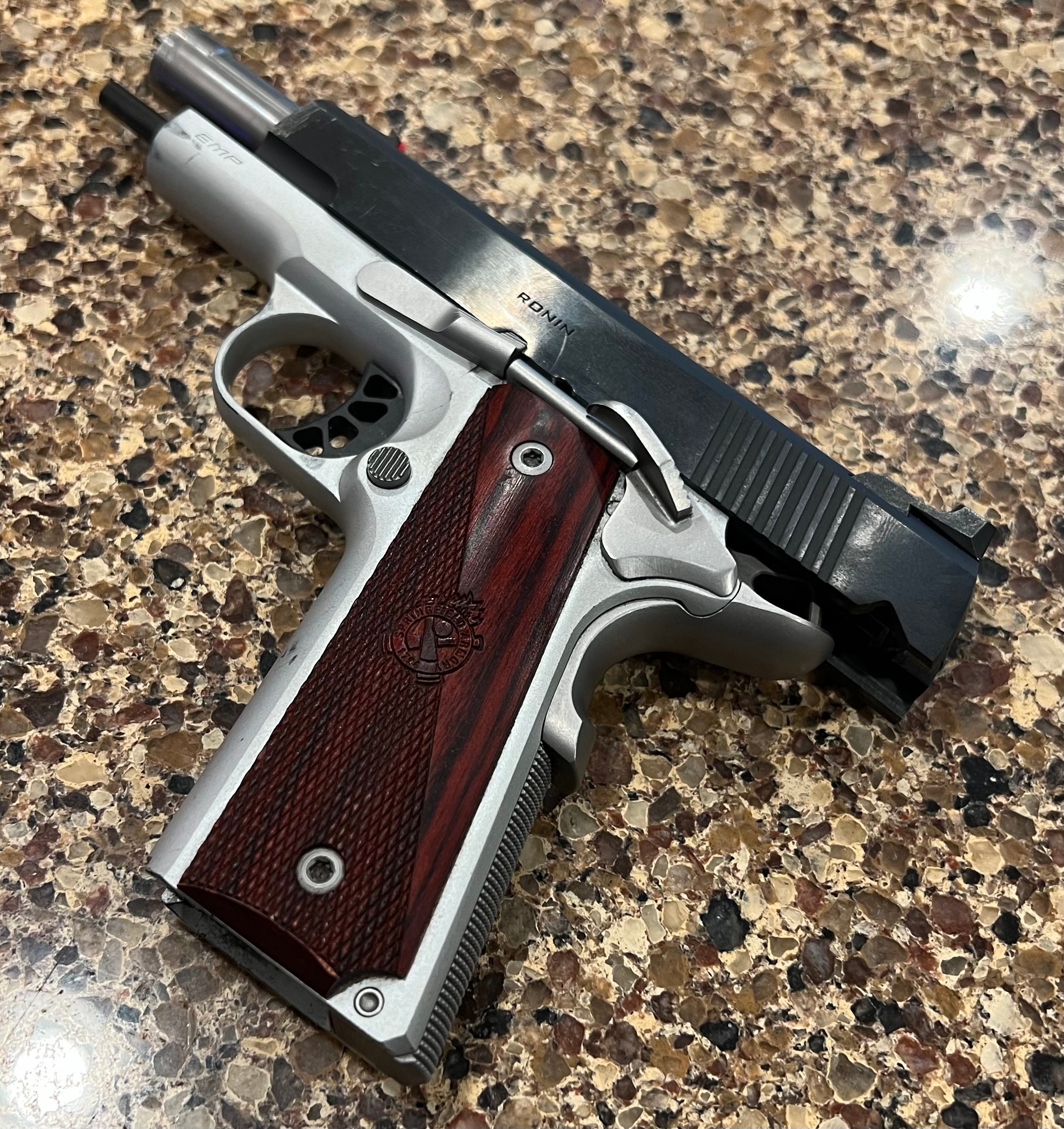
For the purpose of being helpful only, here’s some pictures of a variety of holsters that I use with a Springfield Armory 4” 1911 Ronin pistol. This shouldn’t be construed as any sort of training or guidance. And I am not a lawyer, so do not take any of this as legal advice on concealed or open carry.
Here’s the pistol. Note that it is clear and safe before I holstered the weapon or did anything else with it. This is my everyday carry (EDC) for those who are in the gun world.
Here’s my 3 standard holsters that I use. A couple things to notice about all 3 holsters. 1. All of them fully cover the trigger and trigger guard. 2. All of them are designed and fitted to this specific pistol. 3. All of them fully cover the thumb safety. This means that I cannot accidentally take the gun off safe or press the trigger while the pistol is holstered. And it means the gun is snug and secure in the holster.
The first holster is similar to the Tenicor holster the agent was using, except that it’s leather. This is a leather holster made by Mitch J. Rosen. It’s designed for OWB behind the hip and to pull the gun in tight to your body. This is a good choice for me in the winter time or when I’m wearing a suit or sports coat. This is not optimal for concealment in lighter clothing and it requires a lot of drill and practice to reholster safely.


The second holster is my go to for everyday carry. This is a Vedder Light Tuck that I have added Tier 1 Concealed wedges to. It is designed for inside the waistand (IWB) carry, either at the hip or the front of the body. I carry it against my abdomen in the front of my body, also known as appendix carry. It’s incredibly easy to conceal no matter what clothing I’m wearing, it’s fast to draw and it’s the easiest by far to re-holster.
The third holster is my go to for open carry, such as when I’m on the range as a Range Safety. This is an Orpaz Defense Series C holster with a paddle attachment and level 2 retention. This holster stands far out from my body, is intended to ride on my hip or just forward of it, and is a very fast draw. It also has level 2 retention, which means that a safety button must be disengaged before the pistol can be drawn. The button is in a location where my thumb will hit it naturally as I draw, but it is very difficult for anyone else to get their hands on it. Any time you open carry, your holster should have at least level 2 retention, if not level 3.
Here’s some pictures for clarity of what it looks like when I’m wearing the holsters. I didn’t bother with the Orpaz Defense. It’s not concealed carry at all. I will note that it is absolutely the safest for re-holstering, though.


I’m also including a video from Tenicor. They identified that the agent was using their holster and did essentially the same thing I did. They are spot on with all their commentary, which I would expect from Tenicor!
I’m not going to teach you the fundamentals of how to draw, re-holster, etc here. First, the Tenicor video does it pretty well. Second, I do not meet my own criteria above to do so. I’m not a concealed carry instructor and I’ve never actually executed concealed carry and re-holstering in real world, combat scenarios. Third, this is already long winded and that is way too many words.
That said, I hope you got value out of this.
And a quick takeaway if you remember nothing else.
Combat creates stress. Stress dumps cortisol into your body. This causes all sorts of physical stuff, including having a hard time thinking about and executing your plan. To mitigate this, you need to have good equipment, have a good plan, get good training, and drill and practice until it becomes muscle memory.
PS this is not a political post. Please don’t post stuff that is politics or how the USSS is woke or any of the rest. I tackle that other places, but not in this post. I want this post, and the comments section, to be about concealed carry and what we can learn about it from this unique event.
One of the first things I do when changing equipment - meaning "new gun, new holster" or new holster type (ex: kydex instead of leather, or vice-versa) is order a matching Blue Gun to use as a "gun management learning tool." I can work with the blue gun in front of a mirror, or with a video camera, to analyse the draw stroke and re-holster process and refine in complete safety. it. I'm not comfortable carrying a new combination until I've reached the point where I can do "blindfold" draws and re-holsters automatically and instinctively.
And, just like dry fire needs to be practiced frequently - it is a valuable training tool - so does draw and re-holster. With a blue gun it's easy to do it on a schedule. But - remember that important "30-minute mental break" between dry fire / holstering practice and shifting back to a loaded, ready-to-fire gun.
Excellent post, Eric!! I agree completely and believe that your advice is spot on. I appreciate you making it clear that unless we train constantly till our actions become “muscle memory” that our illusions of how well will will perform under stress are definitely going to end in disappointment if not tragedy.
I would recommend that everyone get professional training and then train regularly and work toward simulating stress as much as possible.
Training with former and current Navy SEALS is available and worth it.SEALFit “sheepdog” training is definitely a great idea. Here is a link to a valuable source of the kind of training that would help.
https://training.sealfit.com/sealfit-sheepdog-2