


Tattoos Used to Mean You Were Outside
Say that out loud and watch six perfectly ordinary people explain that they, too, have always lived on the edge.
I recently read one of those pieces about Millennials and Gen Z getting tattooed: a single piece, a sleeve, a hand, a neck. The argument was mostly right. Other ways of standing out have thinned out. Work looks the same. Clothes look the same. Cities look the same. Ink is one of the last cheap ways to look like a person instead of a template.
I am not here to retell that article. I am here to tell you what it looks like from the other side of the needle.
I am the earliest slice of Gen X, born in 1966. When I was a kid in the 1970s, tattoos were not a personality or a trend; they were a census category. I grew up swimming in that subculture. The men who had them were the landscape of my daily life: my grandfather’s construction crew, WWII vets, bikers, and a fair number of guys who had been guests of the county. That was the map. Sailor. Laborer. Outlaw. Not the dentist. Not the teacher. Not the kid who wanted a tasteful sprig of lavender on his forearm because authenticity is a brand now.
Then I joined the Army, and at 20, I got my first piece. That wasn’t an accessory choice; it was a line in the sand. It was part of cutting the cord—deciding I was fully inside that culture, with zero feet left in the normal civilian world.
Combat arms and special operations have always been a tattooed culture. Back in the late ‘80s when I was with the 11th Armored Cavalry Regiment, a bunch of us ran with various Batman motifs—the Dark Knight himself, Catwoman, or whatever fit the grit of the mission. We didn’t pick comic book icons because we were shopping at a convention; they were symbols of operating in the dark and living outside the rules.
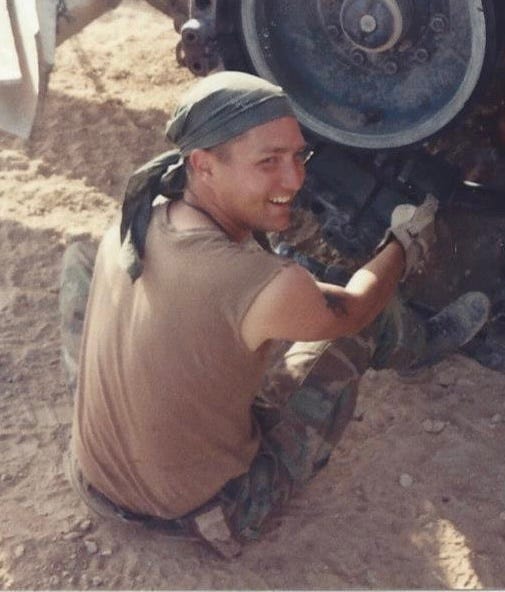
Around 1995 or so, the aesthetic shifted hard into the great wave of tribal ink—endless black bands and sharp geometric work flooding the off-post shops. But if you know how to read it, that ink was always a functional ledger. Just like a patched jacket or prison marks, that old skin told you exactly where a guy came from. If you run into a guy with vintage comic flash melting into mid-90s tribal blackwork, you don’t need to check a DD-214. You’re looking for which Group, Regiment, or heavy armor outfit he ran with.
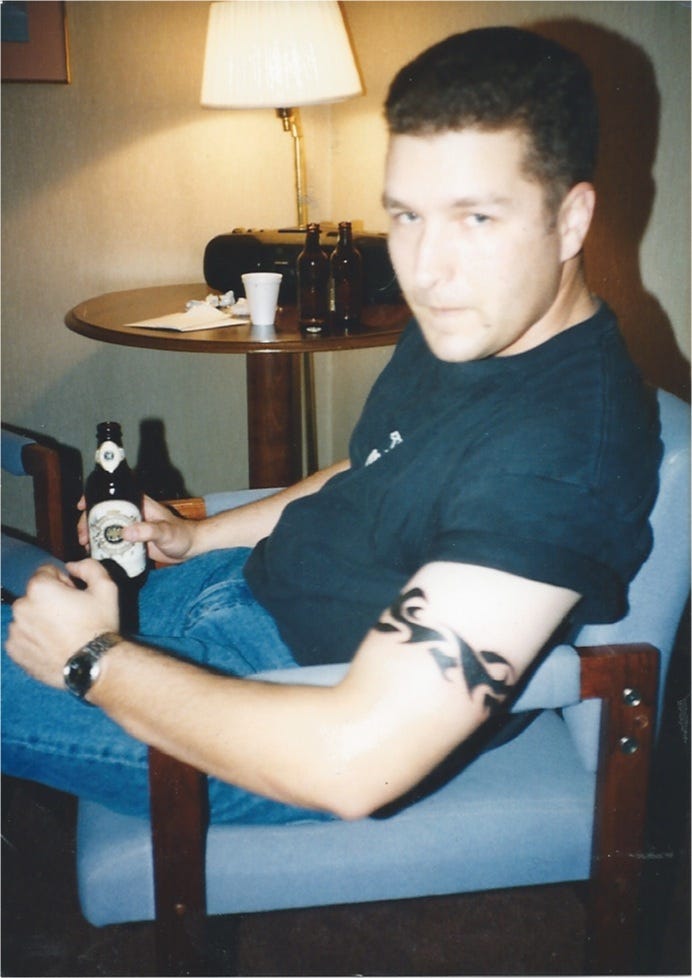
It was bolder, simpler, and it sat on people who already lived outside ordinary civilian life. You could still hide most of it under a uniform. That was part of the point. The ink was for the tribe, not for the algorithm.
From that day well into the 2000s, I lived wrapped in that visibility: large work on both arms and both legs. In the world I came from, that put you firmly outside normal society. Employers noticed. Churches noticed. Mothers noticed.
I learned that firsthand back in the ‘90s when I met my then-girlfriend’s parents. Back then, living together and navigating life outside of marriage wasn’t yet the frictionless default setting it is today; it still carried weight. She knew I was fully tattooed and warned me not to be too in their face, so I wore jeans and a shirt down to my elbows to keep the peace.
She wasn’t just worried about them spotting the ink and pegging me as an outsider to their middle-class culture. She was worried about the math they would eventually do—realizing at some point that their daughter wasn’t just dating a guy with a few youthful indiscretions, but that she knew exactly why he had them and was living in that world right alongside him.
Naturally, I goofed, and my right arm—featuring a full-length Catwoman from elbow to shoulder—peaked out. Ooooops. When no one else was nearby, her mother leaned in, whispered, “Do you have a tattoo?” and waited for the verdict. I looked her dead in the eye and said, “Yes, I have tattoos.” No apologies, no excuses. I somehow managed to survive the meeting and get accepted anyway—pure luck, I guess.
Back then, you paid a social tax for the ink, and that tax was proof that you belonged to a different country than the one in the catalog.
That country got annexed.
Tattoos did not become rare. They became décor. Surveys will tell you a third of adults have at least one, and Millennials sit near the top of that pile. The shop moved from the bad side of town to the same strip as the yoga studio. You can interview with a neck tattoo. You can teach kindergarten with a sleeve if you wear the right cardigan. The signal flipped.
Here is the part that happens every time I say any of this out loud.
I mention that tattooing used to be an outsider culture: sailors, bikers, felons, combat arms. Immediately three or four people in the conversation start explaining that they are outsiders too. They have a sleeve. They have a story. They “never really fit in.” They are, in every visible respect, mainstream kids who have never spent a day outside normal culture in their lives. Good schools. Safe jobs. Parents who paid the deposit. A life that would have been called ordinary in 1978 and is still ordinary now, except the ordinary now comes with ink.
They are not lying to be cruel. They have been taught that identity is a feeling you announce. If the tattoo is how you announce it, then the tattoo must mean you left the herd. It does not occur to them that the herd got tattooed.
That is what is weird as hell if you come from the old tattoo cultures—the ones I saw on the construction sites of the ‘70s and carried through the 11th ACR and the infantry. You are not angry that the art got better. You are watching people wear the old warning sign and then insist the warning was always about their personality.
The irony is that people get tattooed longing to be different, yet the reality is that by doing so en masse, they are just mundanely normal. That is precisely why I haven’t had a new tattoo done in 15 years.
When everyone is tattooed, the tattoo no longer says you left the main road. It says you went to a mall that sells belonging. The biker, the sailor, the convict, the infantryman: those marks used to be a handshake and a caution at the same time. You knew, roughly, what kind of life had put that ink on that skin. Now the same visual language is worn by people who have never been outside in the old sense. They are not in a club that costs you jobs and family dinners. They are in a club that costs you a Saturday and a credit card.
I still have the ink. I still know what it cost when I got it. That cost is the part the new fashion cannot buy. You can copy the lines. You cannot retroactively join the world that made those lines a boundary.
And you cannot talk your way into that world by telling a tattooed sergeant that you, too, have always been a little different. I already know what different used to look like. It did not look like the coffee shop.
Great piece and so true. This is one of my favorites of your work.