


There’s been a surge of loud voices calling for the 25th Amendment to be used to remove President Trump from office. They make it sound simple, almost routine — like a constitutional off-switch for a president they dislike. It is neither simple nor routine.
Most Americans don’t fully understand the 25th Amendment, so let’s break it down clearly. Some parts are straightforward. Others are extraordinary — giving the Vice President and Cabinet the power to temporarily sideline a sitting president, with Congress as the final referee. Critics have called Section 4 a “legal coup d’état” mechanism built into the Constitution.
Quick Summary of Each Section
Section 1: Permanent Succession
If the president dies, resigns, or is removed from office (for example, through impeachment and conviction), the vice president automatically becomes the full president — not just an acting one.
Section 2: Filling a Vice Presidential Vacancy
If the vice presidency becomes vacant (death, resignation, or ascension to the presidency), the president nominates a replacement.
The nominee must be confirmed by a simple majority vote in both the House and the Senate.
Section 3: Voluntary Transfer of Power
If the president knows they will be temporarily unable to perform their duties (e.g., surgery or serious illness), they can send a written declaration to Congress.
The vice president immediately becomes Acting President.
Once recovered, the president sends another letter reclaiming power, and it returns automatically.
Section 4: Involuntary Transfer of Power (The Controversial One)
If the president is unable to discharge the powers and duties of the office but refuses to step aside, the vice president plus a majority of the Cabinet (or another body designated by Congress) can send a written declaration to the Speaker of the House and the President pro tempore of the Senate.
The vice president immediately becomes Acting President.
The president can contest this by declaring they are able to serve.
The vice president and Cabinet then have four days to push back in writing. If they do, Congress must decide the issue (assembling within 48 hours if not in session).
Congress has 21 days to vote. The vice president remains Acting President only if two-thirds of both the House and the Senate agree that the president is unable. Otherwise, the president resumes full power.
How the 25th Amendment Has Actually Been Used
The amendment has been invoked a handful of times since 1967 — but never under the dramatic involuntary process of Section 4. Here’s the quick history:
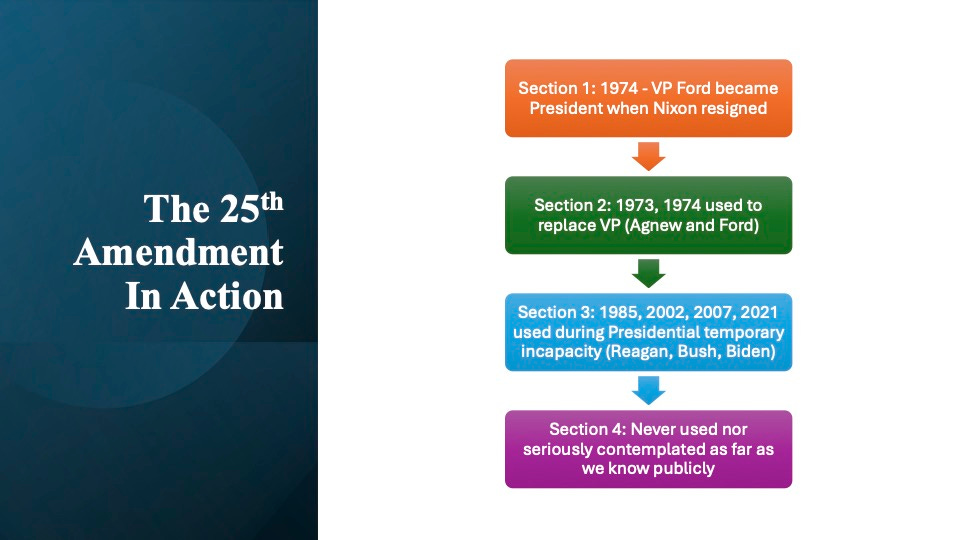
Section 2 (Vice Presidential Vacancy) was used twice in the 1970s:
In 1973, after Vice President Spiro Agnew resigned, President Nixon nominated Gerald Ford, who was confirmed by Congress.
In 1974, after President Nixon resigned (and Ford became president under Section 1), Ford nominated Nelson Rockefeller as vice president, who was also confirmed.
Section 3 (Voluntary Transfer) has been used four times, all for short, planned medical procedures under anesthesia:
President Ronald Reagan in 1985 (power transferred to Vice President George H.W. Bush for several hours).
President George W. Bush in 2002 and again in 2007 (power transferred to Vice President Dick Cheney for about two hours each time).
President Joe Biden in 2021 (power transferred to Vice President Kamala Harris for roughly 85 minutes).
In every real-world case, the transfers were brief, consensual, and uneventful. Section 4 — the one that allows the vice president and Cabinet to act against the president’s will — has never been invoked.
Bottom line:
The 25th Amendment does something the Founders never explicitly designed: it creates a mechanism for the vice president and Cabinet to remove a president’s authority — at least temporarily — with Congress’s involvement. If the president fights back, it requires the same high bar as overriding a veto or convicting on impeachment: a two-thirds vote in both chambers.
However, if the president never contests the declaration (or is truly incapacitated), the vice president and a simple majority of the Cabinet can effectively sideline him. That’s an enormous amount of power concentrated in unelected officials and one elected running mate.
This is what some Democrats, media figures, and even a few others are pushing for right now. It almost certainly won’t succeed — it has never been successfully invoked under Section 4 — but success may not be the real goal. The aim often seems to be to portray the president as unfit, erode public confidence, and normalize the idea that removing him is the responsible, patriotic thing to do.
It carries strong echoes of the late Roman Republic, where norms eroded and extraordinary measures became routine tools in political combat.
This is exactly the kind of institutional norm erosion I’ve been exploring in the Observations from the Late Republic series. What we’re seeing with casual calls to invoke the 25th Amendment is not mere political disagreement — it is the gradual normalization of extraordinary constitutional tools as routine political weapons. Just as the late Roman Republic slowly accepted the use of violence, private armies, and extra-legal maneuvers until the old guardrails became meaningless, we risk making once-unthinkable mechanisms feel ordinary. The Republic does not fall in a single dramatic moment. It erodes, one normalized exception at a time.
Observations from the Late Republic
#Observations #25thAmendment #Constitution #Section4 #PoliticalCoup #NormErosion #PresidentialSuccession #Civics
Section 3 temporary transfers of power are usually only known about after the fact and after the POTUS has reclaimed power, for obvious natsec reasons.