


Reclaiming the Meaning of Our Constitution and Bill of Rights. Understanding the three tools of liberty: conscience, communication, and self-defense. Which are enabled with the bible, the typewriter, and the gun.
There is a fundamental inversion at the heart of today’s political discourse. Flip on the news, listen to a congressional debate, or read modern legal commentary, and you will quickly encounter a quiet, dangerous assumption: that our rights are gifts handed down by the government. In this upside-down worldview, the state is the benevolent provider of free speech, the custodian of our safety, and the grantor of our liberties, which it can therefore regulate, license, or revoke as it sees fit.
To anyone sitting down with a clear mind, a glass of bourbon, and a good cigar, this perspective isn’t just historically illiterate, it is a direct threat to the American experiment.
To understand the Constitution, we have to return to first principles. Look no further than the document’s Preamble, which tells us precisely who comes first. It is binding because it is the exact place where We, The People create the government to protect our pre-existing rights and liberties. The individual person comes first. Inalienable rights belong to human beings by virtue of their existence, granted by their Creator, long before any government draws a border, passes a law, or writes a constitution. Government is not the source of these rights; rather, government is an artificial structure created by individuals strictly to secure and protect them. The Constitution and its Bill of Rights are not a leash on the citizen—they are a strict, legally binding leash on the state.
The Architecture of Freedom: Life, Liberty, and Property
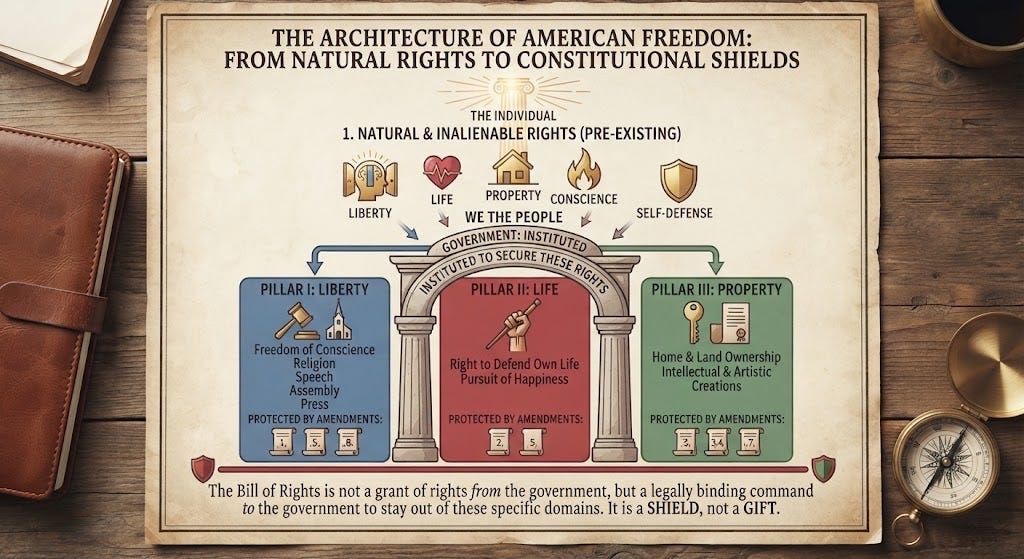
To see how this architecture works, we can map the Bill of Rights directly to the foundational triad of individual rights: Life, Liberty, and Property.
Liberty means we possess the inherent freedom of conscience, religion, association, assembly, and movement. The First, Fifth, Sixth, and Eighth Amendments do not grant these freedoms; they build an impenetrable wall around them, explicitly forbidding the government from infringing upon them.
Life means we have the fundamental right to defend our own lives, to live them as we see fit in the pursuit of happiness, and to own and use the tools necessary to do so. The Second and Fifth Amendments protect that reality.
Property means that our homes, our land, and our intellectual and artistic creations belong to us, not the collective. The Third, Fourth, and Seventh Amendments protect our domains from trespass, unwarranted search, and arbitrary seizure.
In every single instance, the Bill of Rights acts as a shield. It tells the government: These domains are off-limits.
Reclaiming The Press, The People, and The Militia
To properly read our founding charter, we have to remember what the Constitution actually is. It is a contract for government. It establishes who the parties to that contract are: the people, the states, and the federal government. Furthermore, it is a well-established matter of law that contracts must be interpreted based on the common understanding at the time and place they were written.
Unfortunately, over two centuries of political spin have distorted these clean lines, twisting clear English into legalese designed to expand state power. To reclaim our foundational documents, we have to strip away modern myths and look at what these terms meant to the generation that wrote them in 1790.
Let’s start with “the press.” Today, we are conditioned to think of the press as an institutional guild. Everyone talks about the press as a privileged class of corporate journalists employed by major media outlets. But in the founding era, “the press” meant anyone who put ideas to paper or reported on events. Thomas Paine writing Common Sense in his home and paying for its printing out of his own pocket was “the press.” And so were the countless common citizens who wrote anonymous pamphlets, printed broadsheets, and distributed them to their neighbors.
If you want to think of it this way, the pamphleteers of the American Revolution were the forerunner of today’s bloggers and X journalists. The press is a technology and an action, not a corporate badge. Notably, the press comes before the First Amendmen. It was viewed as a natural extension of free thought, not a government-regulated industry.
The same semantic distortion plagues the Second Amendment. In 1790, the term “militia” meant the able-bodied adult citizens of the nation. The Founders fully intended the People to have weapons …. to keep arms …. and to take them up in defense of themselves, their homes, and their nation …. to bear arms.
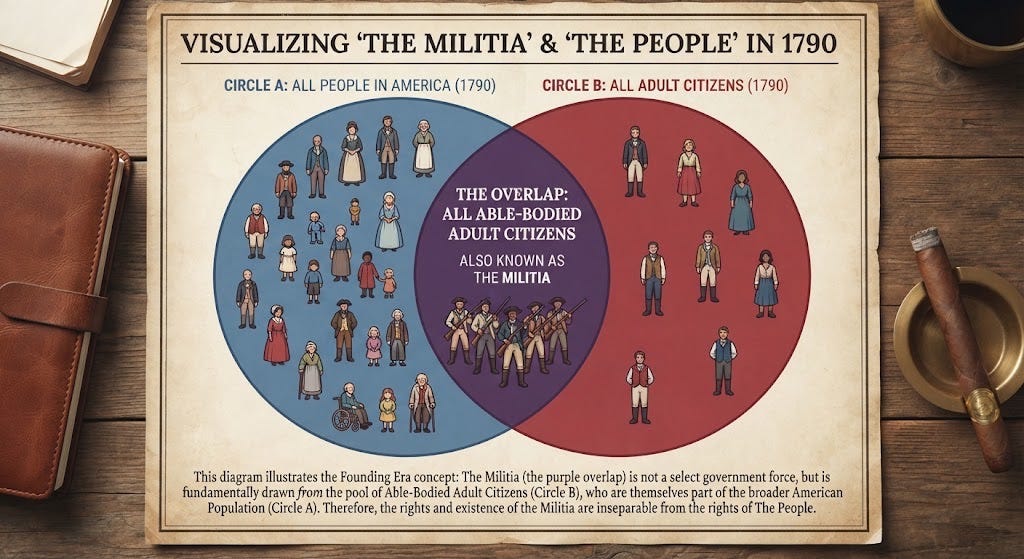
When the Second Amendment references a well-regulated militia, it is not creating a prerequisite or a select government-authorized fighting force that alone can own weapons. The Founders viewed a standing army with deep suspicion, knowing that tyranny always wears a uniform. Instead, the prefatory phrase (”A well regulated Militia, being necessary to the security of a free State...”) explains why the right exists: because a free country relies on a capable, armed citizenry for its ultimate defense.
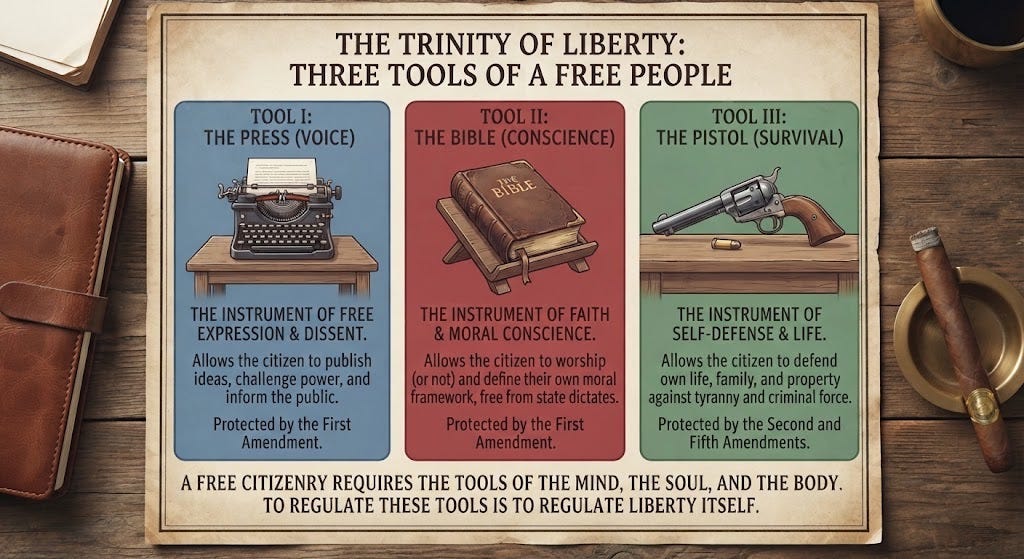
The Founders did not believe the militia were the only ones who could keep and bear arms; they applied that right to The People as a whole. To grasp how absurd the modern “collective right” argument is, consider a parallel: we would never argue that an adult citizen requires government permission, a background check, or a license in order to own a Bible or a typewriter. Just as a printing press is the tool of free speech and a Bible is the tool of conscience, arms are the tools of self-defense and life. Most certainly, Josef Stalin would believe that a citizen must have the permission of the government to own a typewriter, a Bible, or a pistol. And that is precisely why the citizens of a free republic must never allow the government to regulate those three things above all. If you don’t need a permit to own the tools of your liberty, you certainly don’t need one to own the tools of your survival.
Conclusion
The debate over the Constitution isn’t an academic exercise for ivory-tower lawyers; it is a battle for the soul of a free republic. And the citizens of that free republic must engage in the fight. When we forget that our rights are pre-existing and inalienable, we begin to treat freedom as a privilege subject to government approval.
It’s time to shake off the modern distortions. The Bill of Rights doesn’t give us permission to be free; it warns the government to stay out of our way. And keeping that truth alive requires a vigilant citizenry, a sharp eye on Washington, and perhaps a quiet evening to reflect on what it truly means to be a free people.
Further Reading
John Locke, Second Treatise of Government (1689) — The foundational text for natural rights, life, liberty, property, and the social contract. (Read via Online Library of Liberty)
Baron de Montesquieu, The Spirit of the Laws (1748) — The definitive work on the separation of powers as the structural safeguard against tyranny. (Read via Project Gutenberg)
Voltaire, Treatise on Tolerance (1763) — A passionate defense of freedom of conscience, speech, and intellectual independence against state and religious censorship.
Adam Smith, The Wealth of Nations (1776) — Explores economic liberty, spontaneous order, and the rejection of arbitrary government control over human enterprise. (Read via Library of Economics and Liberty)
Thomas Paine, Common Sense (1776) — The ultimate example of “the press” in action—a common citizen using print to rally a continent toward independence. (Read via Avalon Project)
The Constitution of the United States and The Bill of Rights (1787/1791) — Read the original contract and its amendments directly, keeping original public meaning in mind. (Read via National Archives)
#Foundations #Constitution #America250