


For most of my life, Americans have been fed two very different but equally cartoonish versions of the Founding Fathers. Both versions are simplistic, both are comforting to their respective audiences, and both are fundamentally useless for understanding who these men actually were and what they were trying to do.
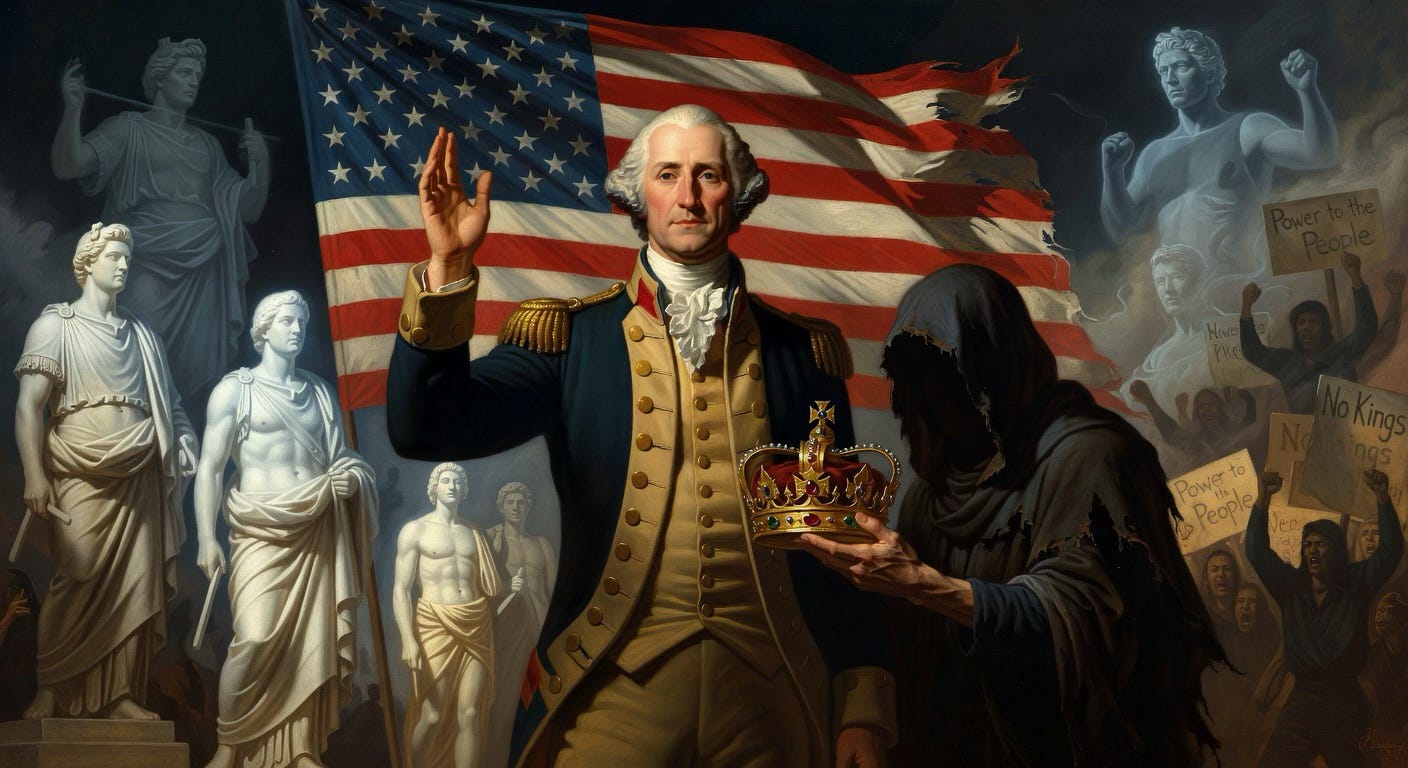
The Old Cartoon: Marble Men
When I was a kid in the 1970s, the Founders were presented as practically perfect demigods. George Washington was the stoic, flawless leader who could not tell a lie. Thomas Jefferson was the brilliant author of the Declaration of Independence. Ben Franklin was the witty, kite-flying grandfather of the nation. The whole group was shown in powdered wigs and solemn portraits as wise, noble, selfless patriots who created a perfect system in a single burst of divine inspiration.
School textbooks, children’s books, and popular culture reinforced the myth. Washington chopping down the cherry tree and confessing immediately. Franklin flying a kite in a thunderstorm to discover electricity. The Constitutional Convention portrayed as a gathering of enlightened sages who agreed on almost everything. The message was clear: these were flawless men on a sacred mission. They didn’t have personal ambitions, political rivalries, or moral contradictions. They were marble statues — perfect, untouchable, and above the messy realities of human nature.
The problem with portraying the Founders as perfect demigods is that they always had very obvious feet of clay. They were ambitious, competitive, vain, and often deeply hypocritical. Many of them owned slaves while writing soaring rhetoric about liberty. They cut political deals that compromised their own principles. They had enormous egos and spent years sniping at each other in private letters and newspapers. They worried constantly about their legacies and reputations. In short, they were complicated, flawed human beings operating under immense pressure in an incredibly dangerous time.
Because they were presented as flawless, it was almost inevitable that a later generation would take savage delight in tearing them down.
The New Cartoon: Devils and Hypocrites
Today we have the opposite cartoon. The Founders are now cast as villains in a morality play. They are reduced to their worst traits — slave owners, rich elites, hypocrites who spoke of liberty while profiting from human bondage. Every flaw is magnified, every compromise is treated as proof of bad faith, and their genuine achievements are downplayed or dismissed as self-serving.
The problem with portraying the Founders as devils is that it requires the same intellectual dishonesty as the old marble men version. It demands we ignore their genuine accomplishments, their profound understanding of human nature and political fragility, and the extraordinary difficulty of what they were attempting. It pretends that moral perfection is a reasonable standard for judging 18th-century men who were trying to build the first large-scale republic in a world still dominated by kings and empires.
A large part of this new cartoon comes from the insistence that figures from the 18th century must be judged by the moral standards of the 21st century. It’s as silly as trying to make Jesus out to be a Socialist or a Libertarian when he lived 2,000 years before those concepts even existed. The Founders were men of their time — brilliant, flawed, and working with the intellectual and moral tools available to them. They were not perfect. They were not monsters. They were serious, highly intelligent people attempting something unprecedented in human history.
The Reality: Better Than Average, Still Human
The actual Founders were neither demigods nor devils. They were complicated, serious, highly intelligent men who were, on balance, significantly better than the average man of the 18th century.
We know this not just from their public actions, but from their private writings. Adams, Jefferson, and Washington especially left behind extensive correspondence that reveals men who were acutely aware of their own historical significance. They understood they were attempting something unprecedented — creating a large-scale republic in a world still dominated by monarchies and empires. They worried constantly about factionalism, debt, standing armies, and the fragility of republics. They studied history obsessively, especially the fall of Rome, because they knew how rare and delicate self-government really was.
The clearest proof is the contrast between George Washington and Napoleon Bonaparte. Both were brilliant military leaders who played decisive roles saving their revolutions. But where Washington voluntarily gave up power after victory and helped give birth to a republic, Napoleon seized power, crowned himself emperor, and gave birth to a dictatorship.
When King George III heard that Washington had stepped down from power and refused to become king, he reportedly said, “If he does that, he will be the greatest man in the world.”
Does that sound like the action of a devil? Or the action of a man who understood both power and restraint in a way most revolutionary leaders never have?
The Founders were not perfect.
They were better than average.
If you live through a brutal, violent revolution and somehow manage to create something that doesn’t become The Terror, or Napoleon’s empire, or the Russian Civil War, or Mao’s Great Leap Forward, or the Killing Fields… you did something fucking amazing.
Americans today take this shit for granted. We act like a stable constitutional republic was the default outcome of revolution. It wasn’t. It was the rare exception. The Founders pulled off something historically extraordinary — and we’re currently testing just how durable their creation really is.
The real story is better. It’s messier, more tragic, and far more instructive.
And right now, in our own time of Late Republic crisis, we need the instruction.
Further Reading
If you want to move beyond the cartoons and meet the real Founders, here are some excellent modern works:
His Excellency: George Washington by Joseph J. Ellis – The single best one-volume biography of Washington. Balanced, insightful, and deeply human. Essential reading.
Founding Brothers by Joseph J. Ellis – Brilliant look at the key relationships and conflicts among the Founders.
Washington: A Life by Ron Chernow – The definitive modern biography. Exhaustively researched and very readable.
1776 by David McCullough – A gripping narrative of the critical year of the Revolution.
The Radicalism of the American Revolution by Gordon S. Wood – The best book on how truly revolutionary the American founding actually was.
The Ideological Origins of the American Revolution by Bernard Bailyn – Classic work on the intellectual world that shaped the Founders.
These books show the Founders as they really were: brilliant, flawed, serious men trying to do something extraordinarily difficult. They’re far more interesting — and far more useful — than either cartoon version.
If I were king for a day, I’d make every American read these books. Not because I want to force-feed patriotism, but because you can’t properly understand this Republic — or why it’s currently in trouble — without knowing the real story of the people who built it.