
The Principate: Prologue
The Long Correction

January 20, 2029
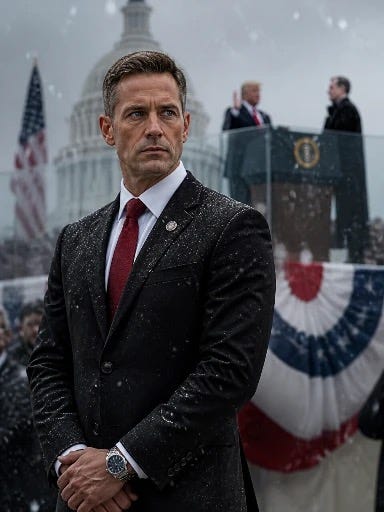
The inauguration of Marco Rubio was colder and more consequential than any in recent memory. Snow dusted the Capitol dome like ash, while nearly half a million people filled the National Mall. Many had not come merely to celebrate the new President. They had come to witness the formal beginning of something irreversible.
The day before, Donald Trump had delivered his farewell address from the same podium. Uncharacteristically restrained, he had looked out over the frozen crowd and said only: “We started the correction. Now it’s up to you to finish it.”
The decisive turning point had arrived the previous year.
After the brutal redistricting wars in early 2026, the GOP had defied every historical trend and held the House in the 2026 elections. That victory finally shattered the Senate Republican leadership’s institutional paralysis. In a closed caucus meeting that would later be spoken of in hushed tones, enough senators told Leader John Thune that nostalgia for the old rules was now suicide. They forced the filibuster’s effective gutting for major legislation.
With their narrowed but workable majority, they drove the SAVE America Act through both chambers in a single, brutal session: strict national voter ID, proof of citizenship for federal elections, deep structural cuts to the administrative state, and ironclad border security measures. What the old regime called the “Fifth Branch” — that vast, unaccountable administrative apparatus — was not destroyed overnight, but it was broken and forcibly re-subordinated to elected authority.
Two downstream effects reshaped American politics for the next generation.
First, the feared Democratic retaliation never materialized. The structural changes proved durable. Democrats would not control the Senate again for decades.
Second, once states implemented real voter ID and citizenship verification, roughly four million ballots quietly vanished from the system. Later academic studies — often conducted in the deepest blue strongholds — estimated that roughly eighty percent of those vanished votes had been cast for Democrats. The old regime called it “voter suppression.” The emerging Principate called it “honest elections.”
The electoral realignment that followed was tectonic. The coastal enclaves remained hermetically blue. Everywhere else the ground shifted hard. Swing states turned solidly pink. By the early 2030s the new structural reality was undeniable: the GOP could reliably count on a Senate majority of roughly 60–40 and a comfortable working House majority.
Between 2025 and 2029 the administrative state was humbled. USAID was dismantled. The Department of Education was devolved. Careerists who had spent decades treating elected officials as temporary inconveniences suddenly found themselves reporting upward again — or out the door.
Yet the Republic had not returned to some pristine 1789 form. Power had simply shifted. The executive — still formally the President in every public ceremony and legal document — now dominated the federal government in practice. Sixty to seventy percent of real decision-making authority flowed through one man, checked not primarily by the other branches, but by something newer and more primal: the Fourth Branch — the armed, educated, awakened citizenry that had delivered the Long Correction and now stood as both base and ultimate restraint.
This was the Principate in embryo. Republican forms endured. The name “President” endured. But those who mattered understood the new reality.
On that frigid January morning, as Marco Rubio placed his hand on the Bible and took the oath, Daniel “Danny” Reyes stood a precise thirty yards away in the protective cordon, eyes scanning the crowd through tinted lenses. Breath fogged slightly in the cold. His left thumb brushed the blue dial of the Tag Heuer he had bought the week he rotated home from Iran. The luminous hands still reminded him of tracer fire over the Persian Gulf.
Today the Princeps is sworn in, he thought. Tomorrow the real work begins.
Reyes was not yet Director of anything. He was still a senior operator from 1st SFOD-D aka Delta Force, pulled into an advisory role as the new administration hurriedly stood up what would become the Executive Protection Service. The EPS did not exist on paper yet. It was being forged in classified briefings and late-night planning sessions — a lean, lethal fusion of Secret Service professionalism, Special Forces operational tempo, and direct-action capability meant to protect the man who now carried the lion’s share of American power.
Two weeks later, in the Oval Office, President Rubio would look across the Resolute Desk at the quiet, olive-skinned operator with the ice-blue eyes and say: “The War Department agrees. We’re formalizing the EPS. I want you as Director.”
Reyes had simply nodded once. “Yes, Mr. President.”
The snow kept falling on the Mall. The Republic — now something both older and newer — held its breath.