


We are witnessing something deeply concerning in American politics: the steady normalization of lawfare — the use of legal institutions and state power as weapons against political opponents. In two earlier essays, I documented how this practice has become routine and how even attempts by the Supreme Court to impose guardrails are being resisted or worked around.
This is not ordinary partisan conflict. It is a structural danger that echoes the final decades of the Roman Republic. When elites begin treating the law as just another tool to destroy rivals, republics start to break down. But America has one critical advantage Rome never possessed — and the real long-term threat today is the erosion of that advantage.
Rome had three branches of government, like America — consuls and proconsuls as executives, the Senate as the dominant legislative body, and praetors acting as judges. However, at the highest levels the judicial function often collapsed back into the Senate, and the branches were poorly separated.
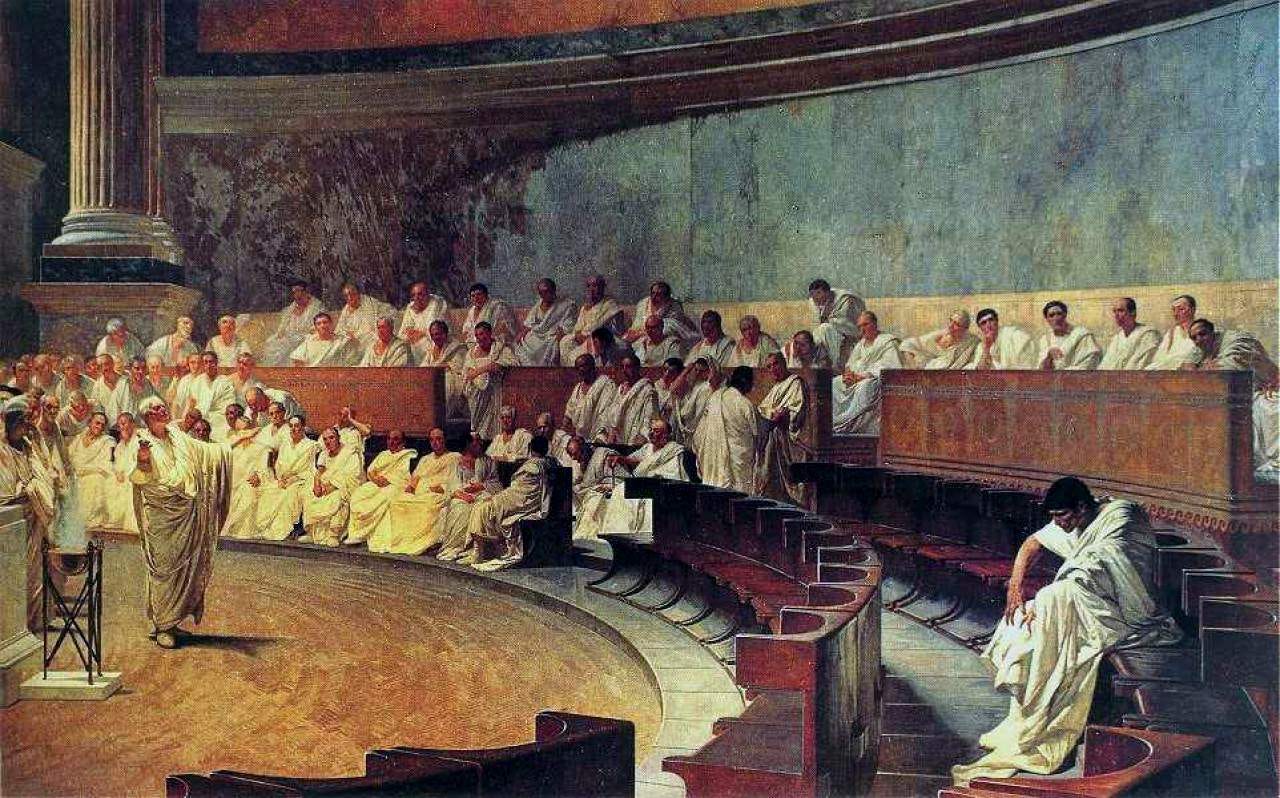
When the Gracchi brothers exposed real problems of inequality and elite land concentration in the late second century BC, they broke important norms in their attempt to address them. The Senate’s harsh reaction — including violence — only escalated the conflict. This eventually led to the First Triumvirate, an extra-legal private agreement between Caesar, Pompey, and Crassus. These three powerful men believed they were stabilizing a dysfunctional Republic by working around its broken institutions. Instead, they tore the guardrails off. Caesar ultimately crossed the Rubicon not purely from naked ambition, but because he concluded that if he laid down his command, his enemies would destroy him through the courts. Once enough Romans believed the old norms no longer protected them, the Republic’s fall became almost inevitable.
In roughly one paragraph we just summarized 100 years of Roman history — from the Gracchi brothers through the First Triumvirate to Caesar crossing the Rubicon. Mike Duncan, please be gentle.
The American Founders, having studied Rome’s failure in detail, deliberately designed a better system. They created three formal branches with stricter separation of powers — but they did not stop there.
They explicitly empowered a Fourth Branch: the sovereign, educated, and armed citizenry itself.
This Fourth Branch is not accidental or implied. It is textually anchored in the Constitution:
The First Amendment protects the free exercise of religion, speech, press, assembly, and petition — giving citizens the tools to monitor, criticize, hold power accountable, and live according to their own conscience.
The Second Amendment guarantees the right to keep and bear arms — ensuring the people remain capable of defending liberty and serving as the ultimate check on elite tyranny.
The First and Second Amendments together create the practical foundation for a self-reliant, sovereign citizenry that doesn’t merely vote every few years — it actively monitors, criticizes, lives by its own conscience, and retains the capability to resist overreach.


Beyond the text, the Fourth Branch rests on the Founders’ profound belief that American citizens must be self-reliant, informed, and ready to act as the final guardians of the Republic.
George Washington repeatedly stressed the necessity of an armed and virtuous citizenry. Thomas Jefferson argued that the tree of liberty must occasionally be refreshed with the blood of patriots and tyrants, and he placed great faith in an educated yeomanry. Thomas Paine, whose writings helped ignite the Revolution, saw the citizenry as the true sovereign power — active, vigilant, and never fully dependent on the state. James Madison, in Federalist No. 46, warned that the ultimate security against tyranny would lie in “the advantage of being armed” and in a militia composed of the body of the people.
This combination — explicit constitutional rights plus a deep cultural conviction in a self-reliant citizenry — gave America something Rome never had, and that England and France never fully achieved: a powerful, living Fourth Branch capable of serving as the ultimate check on elite power and institutional capture.
Today, aggressive lawfare, selective prosecution, and open “when we win we will punish them” rhetoric are doing something especially corrosive. They are teaching ordinary Americans that the constitutional rules no longer apply fairly to everyone. When the Fourth Branch begins to lose faith in the legitimacy and neutrality of the system, the Republic loses its greatest safeguard.
We are currently in the late Gracchi phase, where real grievances exist, populism is rising, and elite behavior is escalating. But the broad mass of citizens still wants the system to work and still believes self-correction is possible.
This series will explore that tension. The first two articles were written last year, and the rest are coming shortly. Without further ado, Observations From The Late Republic!
Article 0: This particular article that talks about the Fourth Branch and is also the framing article for the whole series, although the first two articles were already written.
Article 1: Lawfare Has Begun — The weaponization of legal institutions against political opponents
Article 2: Even the Supreme Court Can’t Stop It — When guardrails are ignored and lawfare continues to escalate
Article 3: The Fourth Branch — America’s unique invention (and the modern Minuteman as its practical embodiment)
Article 4: The Erosion Begins — How lawfare is weakening the Fourth Branch
Article 5: Forces Against the Fourth Branch — Gramsci, Critical Theory, and the rise of the Fifth Branch
The Republic is not doomed. Understanding the historical pattern and recognizing the central importance of the Fourth Branch is the first and most important step toward course-correction. We still have time to strengthen the citizenry, restore trust in fair rules, and reject the cycle of retaliation — but only if we act while the Fourth Branch still retains its faith in the system.
The goal is not to cross any rivers. The goal is to prevent the conditions that make crossing them seem necessary.
Observations From The Late Republic
#observations #LateRepublic #FourthBranch #Founders #Constitution #RevolutionaryEra
I look forward to the rest of your series.
Yeah the judiciary is out of control now