


The two previous articles in the Observations from the Late Republic series examined how lawfare — the weaponization of legal institutions against political opponents — has become normalized in modern America. We saw how even the Supreme Court’s attempts to set boundaries have been met with resistance and creative workarounds.
This raises a deeper question: Why is this pattern so dangerous? To answer it, we must return to one of the most important lessons from the fall of the Roman Republic.
Rome had institutions that looked, on paper, somewhat like our own. Yet it collapsed into civil war and dictatorship. Does that mean we are bound to, also?
America was designed with a crucial difference — one that the Founders hoped would prevent the same fate. That difference is the Fourth Branch: the sovereign, educated, and armed citizenry itself.
Rome’s Warning
Rome had three branches of government, like America — consuls and proconsuls as executives, the Senate as the dominant legislative body, and praetors acting as judges. It also possessed a constitution of sorts (the unwritten mos maiorum and the Twelve Tables) and a rudimentary form of federalism through its system of alliances, municipia, and provinces. However, at the highest levels the judicial function often collapsed back into the Senate, the branches were poorly separated, and real power tended to concentrate in the hands of a narrow elite.
The crisis began in earnest with the Gracchi brothers in the late second century BC. They exposed deep problems of inequality and elite land concentration and attempted reforms that broke long-standing norms. The Senate’s harsh reaction — including violence — only made things worse. In the decades that followed, political violence became normalized. Armies shifted from being loyal to the Republic to being loyal to their generals.
This culminated in the Roman Civil War between Marius and Sulla, which set the precedent for using military force to settle political disputes and marked a point of no return for republican norms.
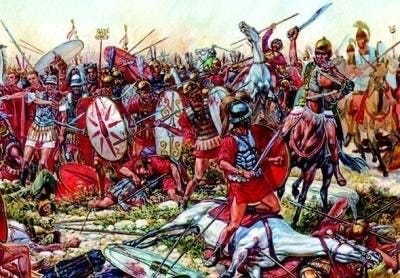
By the time Caesar, Pompey, and Crassus formed the First Triumvirate in 60 BC — an extra-legal private agreement to divide power among themselves — the Republic’s guardrails had already been largely torn down. Caesar ultimately crossed the Rubicon not purely from naked ambition, but because he concluded that if he laid down his command, his enemies would destroy him through the courts. Once enough Romans believed the old norms no longer protected them, the Republic’s fall became almost inevitable.
In roughly one paragraph we just summarized 100 years of Roman history — from the Gracchi brothers through the First Triumvirate to Caesar crossing the Rubicon. Mike Duncan, please be gentle.
America’s Unique Solution
The American Founders, having studied Rome’s failure in detail, deliberately designed a better system. They created three formal branches with stricter separation of powers — but they did not stop there.
They explicitly empowered a Fourth Branch: the sovereign, educated, and armed citizenry itself.
This Fourth Branch is explicitly rooted in the Constitution:
The Preamble declares that “We the People” are the ultimate source of authority and that the Constitution is established to secure the blessings of liberty for ourselves and our posterity.
The First Amendment protects the free exercise of religion, speech, press, assembly, and petition — giving citizens the tools to monitor, criticize, hold power accountable, and live according to their own conscience.
The Second Amendment guarantees the right to keep and bear arms — ensuring the people remain capable of defending liberty and serving as the ultimate check on elite tyranny.
The First and Second Amendments together create the practical foundation for a self-reliant, sovereign citizenry that doesn’t merely vote every few years — it actively monitors, criticizes, lives by its own conscience, and retains the capability to resist overreach.


This vision of a self-reliant, vigilant citizenry did not remain abstract. It found practical expression in the colonial Minutemen — the quick-reaction force of able-bodied citizens who could assemble in minutes to defend their communities. Today, the modern Minuteman embodies the same idea: ordinary citizens who maintain the readiness, skills, and mindset to protect their families, neighbors, and constitutional order in moments of crisis or breakdown. The Fourth Branch lives not only in rights written on paper, but in the daily practice of prepared, engaged citizens.
George Washington repeatedly stressed the necessity of an armed and virtuous citizenry. Thomas Jefferson argued that the tree of liberty must occasionally be refreshed with the blood of patriots and tyrants, and he placed great faith in an educated yeomanry. Thomas Paine, whose writings helped ignite the Revolution, saw the citizenry as the true sovereign power — active, vigilant, and never fully dependent on the state. James Madison, in Federalist No. 46, warned that the ultimate security against tyranny would lie in “the advantage of being armed” and in a militia composed of the body of the people.
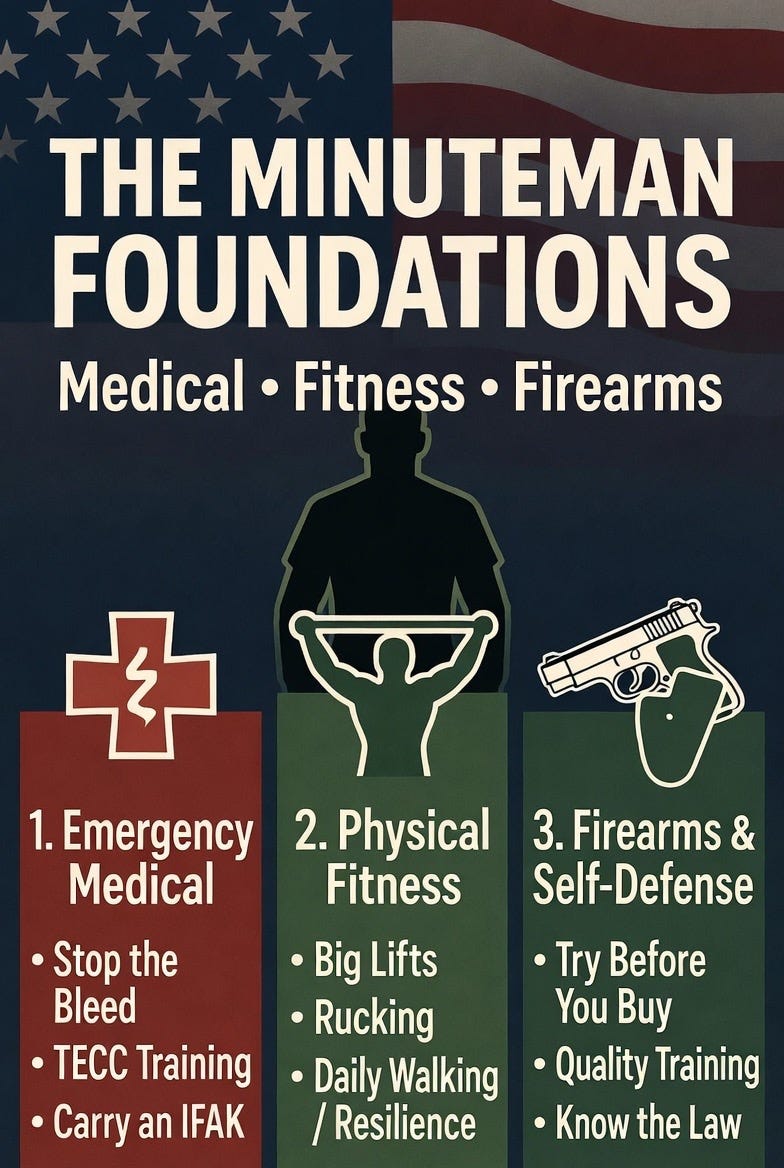
This combination — explicit constitutional rights plus a deep cultural conviction in a self-reliant citizenry — gave America something Rome never had, and that England and France never fully achieved: a powerful, living Fourth Branch capable of serving as the ultimate check on elite power and institutional capture.
Why the Fourth Branch Matters
A healthy Fourth Branch acts as the ultimate firebreak against the kind of decay that destroyed the Roman Republic. As long as citizens remain informed, self-reliant, and confident that the constitutional order treats them fairly, elite overreach and lawfare are far more difficult to sustain. When that faith erodes, the Republic becomes vulnerable.
This erosion is already well underway. Over the past century, a new and powerful force has risen — the Fifth Branch: a self-perpetuating network of politically empowered elites, bureaucratic institutions, media, academia, and cultural gatekeepers. Unlike the original three branches, which are at least formally constrained by the Constitution, and the Fourth Branch, which is rooted in the citizenry, the Fifth Branch operates largely outside democratic accountability.
Article 4 will trace how this Fifth Branch emerged — beginning in the Reconstruction era, accelerating through the World Wars and the Cold War, and reaching its current form in the modern struggle between the sovereign citizenry (the Fourth Branch) and the entrenched elite class (the Fifth Branch). In this conflict, the original three branches often find themselves sidelined or captured, while major political figures ride the tiger of these colliding cultural and institutional forces.
Further Reading
For more on the Founder’s Vision and the Virtuous Citizenry:
Thomas E. Ricks First Principles: What America’s Founders Learned from the Greeks and Romans and How That Shaped Our CountryFor a narrative history of the Late Republic:
Mike Duncan’s book The Storm Before the Storm is excellent.
Observations from the Late Republic
#Observations #FourthBranch #LateRepublic #FoundersVision #CitizenSovereignty #Foundations
Unrecognized by most, perhaps nearly all, today is what this means. Self-government means that we hold the responsibility for our laws and their enforcement. Legislators, executives and judges are our hirelings. To these hirelings we delegate the authority necessary to the roles we have assigned them, most notably enforcing the law through the executive and judicial branches. Unlike authority, responsibility for enforcement cannot be delegated and remains ours.
This is not “vigilantism” when we enforce our laws once our hirelings refuse to. It is the definition of self-government.
Well written and easy to follow. Thank you.