


Post Update
Thanks to Instapundit for the link.
If you’re coming over from Instapundit, welcome!
This piece is part of my ongoing Observations from the Late Republic series, where I look at how America today echoes the late Roman Republic — particularly the pressures free societies face from ideological violence, institutional strain, and the challenge of not losing our nerve.
If you enjoyed this one, you might also like:
The full series lives here: Observations from the Late Republic
While you’re here, if you’re in the mood for something completely different, I also write a fun daily pulp-style zombie apocalypse serial called Bougie Apocalypse — think World War Z meets Zombieland with heirloom beans, good coffee, and refusing to let the end of the world turn us into savages.
Check it out here: Bougie Apocalypse
I’ve been thinking about the violence, the ideological conflict, and the reality that more is to come. The key right now is to stand firm and not to lose our nerve.

On April 25, 2026, another assassination attempt was made on President Trump — this time at the White House Correspondents’ Dinner.
It was only the latest in a growing pattern of political violence and heated rhetoric from segments of the American left. Over the past several years, we have watched advocacy for violence increase, institutions come under sustained ideological pressure, and a clear desire by some factions to fundamentally transform — or replace — core elements of American government and culture.
This is not new in history. Republics have faced similar storms before. In both the German Weimar Republic and the French Fourth Republic, ideological extremists and political militants actively worked to destabilize, disrupt, and change the existing republican order through violence, institutional capture, and relentless pressure. Both republics ultimately collapsed under the strain.
The Spartan Parallel
In Jerry Pournelle’s Codominium universe — particularly the Prince series and the Sparta stories — the planet Sparta faces a brutal, long-term insurgency from the Helots, classic Maoist revolutionaries who seek to overthrow the existing republican order and impose authoritarian control through a combination of political violence, cultural subversion, institutional capture, and open warfare as the Helots gain in strength.
As the situation deteriorates, with assassinations, bombings, and relentless pressure mounting, one of the recurring pieces of advice from the veteran soldier Hal Slater to the Spartan leadership is simple, grounded, and repeated:
“The great thing is not to lose your nerve.”
Pournelle was not writing pure fantasy. He lived through the 1960s and 1970s in America — an era of significant left-wing revolutionary violence, including groups like the Weathermen and Black Panthers who openly sought to overthrow the existing system. He also observed the long, grinding experience of Vietnam, where political will and cultural cohesion often mattered more than raw military power. And he was very aware of what happened to the German Weimar Republic and French Fourth Republic.
The Spartan/Helot conflict feels particularly relevant today because Pournelle drew heavily on those real-world observations. He understood how determined ideological movements can destabilize even strong societies — not always through outright military victory, but by exhausting the defenders’ will, eroding institutions, and fracturing cultural confidence.
Historical Lessons
The German Weimar Republic and the French Fourth Republic both collapsed under pressures that should sound familiar.
Weimar Germany became a carnival of political violence, assassinations, street brawls between extremists, economic chaos, and institutional paralysis. The republic didn’t fall because it was conquered by an outside army — it fell because it lost legitimacy, exhausted its people, and ultimately surrendered to authoritarians who promised order. It got Hitler.
The French Fourth Republic was hardly better. It suffered through chronic instability, revolving-door governments, colonial disasters, and repeated political crises. In 1958 it faced an attempted military coup and open violence in the streets of Paris — complete with barricades — before finally collapsing. Most French citizens barely shrugged when it happened. They were simply tired of the endless dysfunction. France was fortunate that it got Charles de Gaulle — a strongman more in the mold of George Washington than Napoleon Bonaparte.
Both had written constitutions. Both had parliaments. Both had educated populations. What they lacked was the deeper cultural cohesion, institutional durability, and national will to withstand sustained ideological attack and internal sabotage.
They are cautionary tales of what happens when a republic allows its foundations to be eroded while convincing itself that “this time, it will be different.”

The Strength of American Culture & Heritage
We have a widespread, living culture of self-reliance, individualism, and deep skepticism of centralized authority. This isn’t theoretical — it is embedded in our founding documents, our folklore, our habits, and the daily reality of millions of citizens who still believe they have both the right and the duty to manage their own lives.
We have the Constitution and the Common Law tradition — institutions deliberately engineered with a profound understanding of human nature and the corrupting tendency of power. While they have been bent and abused at times, they have proven far more durable than the fragile parliamentary systems that collapsed in Weimar and France.
And perhaps most importantly, America still retains a large, armed, and generally competent citizenry — the “Fourth Branch” — that no previous collapsing republic could match in either scale or spirit.
These are not insignificant advantages. They represent real, historically rare sources of national resilience.
The question facing us is not whether America has the raw material to withstand the current pressures. It clearly does.
The real question is whether we will remember that strength — and refuse to lose our nerve when the pressure intensifies.
The Real Challenge: “Don’t Lose Your Nerve”
It is one thing to insist that existing laws and norms be enforced without fear or favor. It is quite another to decide that the only way to beat the radicals is to become radicals ourselves — to abandon our own principles in the name of “fighting fire with fire.”
This is the temptation some on the right are increasingly flirting with. Seeing institutional capture, cultural aggression, and sporadic political violence, a growing chorus argues we should meet it with our own version of hardball: selective enforcement, extralegal measures, or even darker paths reminiscent of 1980s El Salvador or other dirty wars.
As darkly tempting as it may be in some moments to start tossing communists out of helicopters à la Pinochet, that way lies madness and darkness.
Jerry Pournelle, through Hal Slater, understood this trap. The Spartans were not saints. They were hard, disciplined, and willing to do what was necessary. But the repeated counsel was never “become like the Helots to beat them.” It was “don’t lose your nerve.”
Losing your nerve doesn’t just mean cowardice. It can also mean panic — the panicked decision that our system is so broken that the only solution is to burn it down and rebuild something “stronger.” That path has been tried many times in history. It rarely ends with more freedom.
America’s great advantage is not that we are immune to these pressures. It is that we still have the cultural and institutional tools to resist them without descending into the same authoritarianism our opponents crave. Enforcing the laws we already have — rigorously, consistently, and without apology — is very different from deciding the Constitution is a suicide pact and that we must become what we despise in order to survive.
Love of America and all it stands for remains a powerful force. That love, properly channeled, gives us the strength to endure.
The great thing is not to lose your nerve.
What Maintaining Resolve Actually Looks Like
Maintaining our nerve does not mean passivity or weakness. Quite the opposite.
It means insisting on the rigorous, consistent enforcement of existing laws and norms — without apology and without descending into the same tactics we claim to oppose.
It means rejecting the panicked impulse to “fight fire with fire” by becoming what we despise. It’s still tempting in moments of frustration, but we aren’t going to win in a way we recognize if we start giving commies one-way helicopter trips.
It means protecting and strengthening the institutions and cultural habits that have served us for over two centuries: the Constitution, the Common Law tradition, free speech, secure borders, and an armed, competent citizenry that still believes it has both the right and the duty to defend the Republic.
It means refusing to surrender the moral high ground even when our opponents have long abandoned it.
Hal Slater’s counsel to the Spartans was never about surrender. It was about disciplined, principled combat against the barbarians. The same standard applies to us.
America does not need to become more like its enemies to survive them. It needs to remember that it is America.
Conclusion
America faces real pressure. Ideological violence, institutional capture, and a determined push to remake the country are not imaginary threats. History shows us what can happen when republics lose their nerve under such strain.
But America is not the German Weimar Republic, nor the French Fourth Republic. We possess deep reserves of cultural strength, a resilient constitutional order, and a citizenry that still believes in self-government. These are advantages those failed republics never had.
The great challenge before us is not whether the pressure exists. It is whether we will keep our nerve — and refuse to fall into despair.
Too many conservatives, libertarians, and ordinary Americans see each new outrage and immediately conclude “this is it, the end is here.” Despair is a sin, and in this context it is also a luxury we cannot afford. It is the quiet surrender our opponents count on.
As Hal Slater repeatedly reminded the Spartans: The great thing is not to lose your nerve.
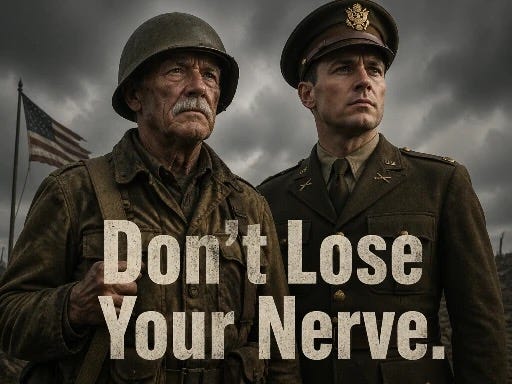
We do not need to become what we oppose in order to defeat it. We need to remember who we are, enforce the laws and norms we already have, and refuse to surrender the moral and cultural ground that makes this country worth defending.
That is how free societies endure.
That is how we keep the Republic.
Further Reading
Jerry Pournelle & S.M. Stirling, Go Tell the Spartans (1991) and Prince of Sparta (1993)
William L. Shirer, The Rise and Fall of the Third Reich
Frank Giles, The Locust Years: The Story of the Fourth French Republic, 1946–1958
Security n Cigars: The Fourth Branch
Observations From The Late Republic
#Observations #DontLoseYourNerve #FourthBranch #LateRepublic #GoTellTheSpartans #IdeologicalViolence #PoliticalViolence #AmericanResilience